
How To Scout For Coyotes
Learn how to find coyotes before the hunt by identifying tracks, scat, travel corridors, food sources, water, vocalizations, livestock activity, aerial imagery clues, and other signs that reveal where coyotes live, travel, and hunt.
What Is The Best Way To Scout For Coyotes?
The most effective coyote scouting combines sign identification, aerial mapping, howling surveys, trail cameras, and observation. Successful hunters locate travel routes, food sources, water, bedding areas, and fresh coyote activity before they ever make a stand.
- Look for fresh tracks and scat
- Locate food and water sources
- Identify travel corridors
- Use aerial imagery and mapping apps
- Confirm activity with vocalizations or cameras
- Turn scouting information into productive stand locations
The hunters who consistently call more coyotes are often the hunters who spend more time scouting. Finding coyotes is usually far more important than debating sounds, equipment, or calling sequences.
The best calling setup in the world cannot call coyotes that are not there. Scouting is often the single biggest factor in coyote hunting success.
Why Scouting Matters More Than Calling
Many new hunters spend most of their time thinking about coyote calls, sounds, and equipment while overlooking the importance of scouting. The reality is that stand location often determines success more than any specific call.
Scouting helps hunters:
- Locate active coyotes before hunting
- Avoid wasting stands in unproductive areas
- Understand travel patterns
- Identify food sources
- Determine stand setup options
- Reduce trial-and-error hunting
Once coyotes are located, hunters can then use effective calling strategies from guides such as Coyote Hunting 101 , Electronic Calling Techniques , and What Sounds To Play & When .
Identifying Coyote Tracks
Tracks are one of the most valuable scouting tools available. They reveal where coyotes are traveling, how recently they were there, and how frequently they use specific routes.
Shape
Coyote tracks are generally oval-shaped and narrower than domestic dog tracks.
Direction
Coyotes often travel with purpose, creating straight-line movement patterns.
Freshness
Sharp edges and undisturbed tracks often indicate recent activity.
Concentrations
Multiple tracks frequently indicate heavily used travel routes.
Dirt roads, two-tracks, field edges, creek bottoms, sandy washes, stock ponds, and muddy water sources often reveal coyote movement.
Using Scat To Locate Coyotes
Scat is another valuable indicator of coyote activity. Coyotes frequently leave scat along roads, trail intersections, ridge tops, and travel corridors where other coyotes can find it.
Territorial Marking
Coyotes often place scat in visible locations to communicate with other coyotes.
Diet Clues
Hair, bones, feathers, and other materials reveal local food sources.
Fresh Activity
Fresh scat often indicates active use of a travel corridor or territory.
Repeat Locations
Repeated scat deposits often reveal heavily traveled routes.
Howling Surveys & Vocalization Scouting
Listening for coyotes can often reveal their location far more efficiently than visual scouting alone.
Many hunters conduct howling surveys during dawn, dusk, and nighttime hours by using locator howls, sirens, or simply listening for naturally vocal coyotes.
Dawn Surveys
Coyotes frequently vocalize during early morning hours.
Dusk Surveys
Evening vocal activity can reveal family groups and territorial boundaries.
Locator Howls
Non-threatening howls may encourage coyotes to reveal their location.
Territory Mapping
Repeated responses help hunters identify core coyote activity areas.
Finding Coyote Travel Corridors
Coyotes rarely move randomly. Most travel occurs along predictable routes that connect bedding areas, food sources, water sources, and territorial boundaries.
Creek Bottoms
Natural travel routes that provide cover, water access, and prey opportunities.
Fence Lines
Coyotes frequently follow fence lines while moving across open country.
Washes & Draws
These terrain features often funnel movement through predictable locations.
Field Edges
Agricultural transitions frequently attract prey and traveling coyotes.
Travel corridors often become ideal stand locations when combined with proper stand setup and wind strategy .
Food Sources, Water Sources & Livestock Operations
Coyotes spend most of their lives near food, water, and security cover. Understanding these resources often reveals where coyotes are likely to spend their time.
Rabbits & Rodents
Areas with abundant prey frequently hold coyotes year-round.
Water Sources
Ponds, tanks, rivers, stock water, and reservoirs often attract both prey and predators.
Livestock Operations
Ranches and agricultural operations often attract coyotes because of food opportunities.
Calving & Lambing Areas
Seasonal livestock activity can create increased coyote concentrations.
Using Mapping Apps & Aerial Imagery
Modern scouting begins long before stepping into the field. Aerial imagery and mapping applications allow hunters to identify likely coyote habitat from home.
Locate Travel Routes
Creeks, washes, ridges, and fence lines become obvious from aerial imagery.
Find Stand Locations
Hunters can identify likely setup locations before ever arriving in the field.
Analyze Wind
Terrain features often reveal likely wind patterns and approach routes.
Improve Efficiency
Digital scouting frequently reduces wasted time and increases productive stands.
Many successful coyote hunters spend hours studying maps before ever entering the field. Digital scouting often reveals opportunities that would otherwise be overlooked.
Example: How To Identify Productive Coyote Hunting Areas
The illustration below shows how many successful coyote hunters analyze a property before ever making a stand. Rather than randomly calling, effective hunters identify bedding areas, travel corridors, food sources, water sources, and likely stand locations before entering the field.
Notice how travel corridors connect bedding cover to food and water. These natural movement routes often become some of the most productive places to scout and hunt coyotes.
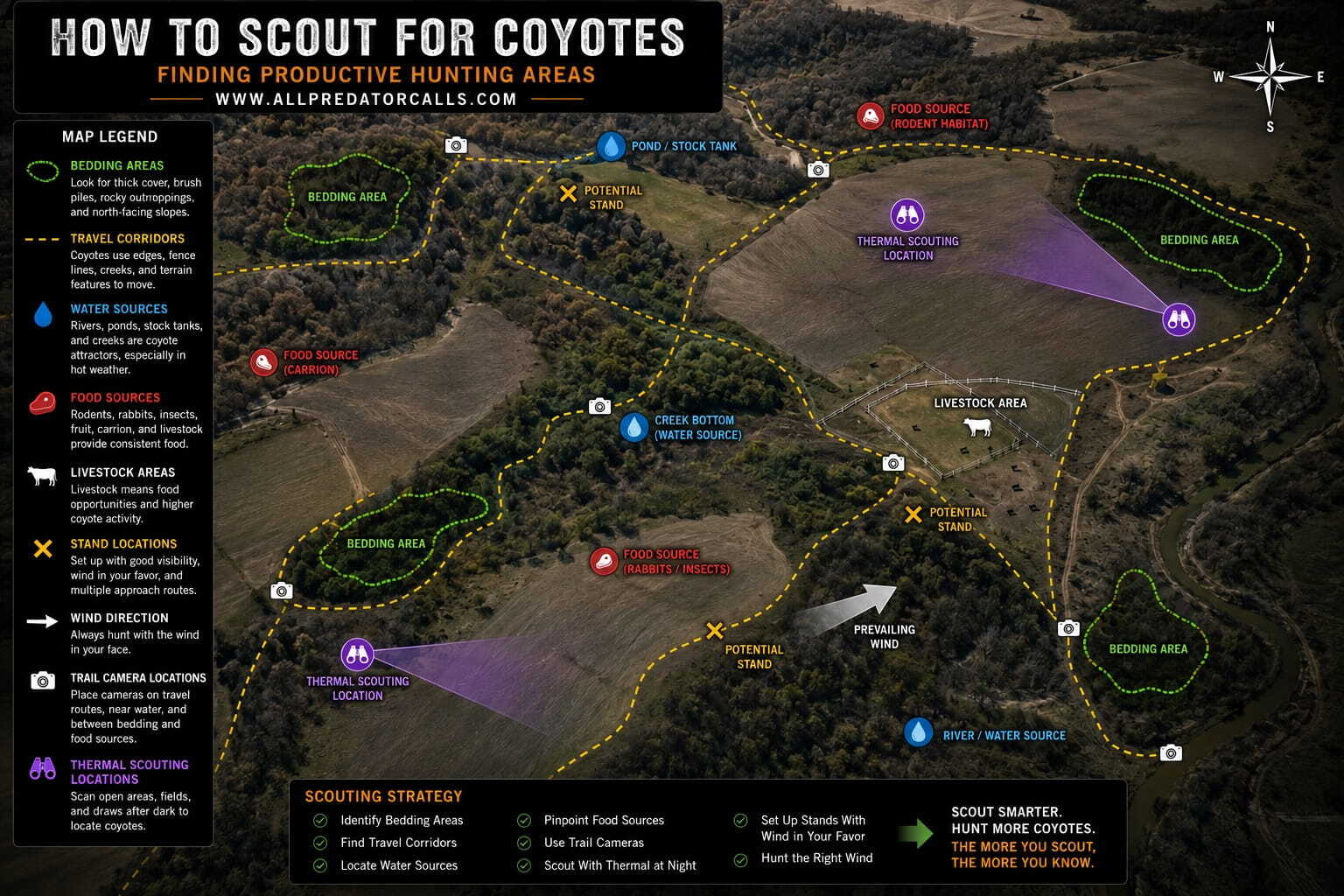
Learning how to scout for coyotes is often the fastest way to improve hunting success. Hunters who consistently locate bedding areas, travel corridors, food sources, water sources, and fresh sign typically experience far more productive stands than hunters who rely solely on calling techniques.
Instead of focusing on a single sign such as tracks or scat, look for multiple clues that connect together. Properties that contain bedding cover, food, water, travel routes, and fresh sign often become the most consistent producers.
Using Trail Cameras To Scout Coyotes
Trail cameras can provide valuable information about coyote activity, travel routes, population density, and hunting pressure. While coyotes often cover large areas and may not pass a camera daily, cameras can help confirm activity in specific locations.
Travel Routes
Cameras placed along roads, trails, creek crossings, and fence lines often reveal regular movement patterns.
Time Of Activity
Photos help determine whether coyotes are primarily active during daylight, nighttime, or transitional periods.
Population Estimates
Multiple individuals photographed regularly often indicate a healthy local coyote population.
Seasonal Patterns
Long-term camera data often reveals seasonal movement changes.
Thermal Scouting For Coyotes
Modern thermal optics have become one of the most effective scouting tools available. Thermal allows hunters to locate coyotes without making a stand, often revealing activity that would otherwise go unnoticed.
Simply observing fields, pastures, ranches, crop edges, and travel corridors after dark can quickly reveal where coyotes spend their time.
Many hunters discover more about local coyote populations during a single evening of thermal scouting than weeks of daytime observation.
For hunters interested in nighttime scouting and hunting, the guide Hunting With Night Vision vs Thermal explains the advantages of each technology.
Night Scouting With Lights
Hunters who use hunting lights often gain valuable scouting information while scanning for predators. Even if a hunter does not intend to shoot an animal, scanning can reveal travel routes, activity levels, and population density.
Night scouting can be particularly valuable during periods when coyotes become heavily nocturnal due to hunting pressure or human activity.
Learn more in: Hunting Predators With Night Lights .
Road Scouting At Dawn & Dusk
Driving roads during low-light periods can reveal a tremendous amount about local coyote populations. Many coyotes are active during dawn and dusk, making these periods ideal for observation.
- Locate coyotes visually
- Identify travel corridors
- Find areas with prey concentrations
- Observe livestock interactions
- Identify future stand locations
Road scouting is often most effective when combined with aerial imagery, sign identification, and follow-up field scouting.
Seasonal Coyote Scouting
Coyotes change their behavior throughout the year. Understanding seasonal patterns allows hunters to scout more effectively.
Spring
Focus on denning areas, pup-rearing habitat, and territorial behavior.
Summer
Concentrate on water sources, food availability, and family groups.
Fall
Young coyotes disperse, creating new opportunities and movement patterns.
Winter
Breeding season activity often increases vocalizations and territorial responses.
Scouting Public Land Coyotes
Public land coyotes often experience more hunting pressure than coyotes on private land. As a result, scouting becomes even more important.
Look for:
- Areas farther from roads
- Less obvious access points
- Terrain overlooked by other hunters
- Remote travel corridors
- Areas with limited human disturbance
Hunters targeting pressured animals should also review: Hunting Pressured Coyotes .
Turning Scouting Information Into Productive Stands
The ultimate goal of scouting is identifying locations that consistently produce opportunities. Once fresh sign and coyote activity are located, hunters must convert that information into effective stand setups.
Play The Wind
Stand location should always consider prevailing wind direction.
Match Terrain
Open country and tight cover require different calling approaches.
Control Visibility
Choose positions that maximize observation while minimizing exposure.
Hunt Fresh Activity
Fresh sign often produces better results than historical information.
Related guides:
Recommended Gear For Scouting Coyotes
Related Coyote Hunting Guides
How To Scout For Coyotes FAQ
The best scouting combines tracks, scat, vocalizations, aerial imagery, trail cameras, and observation.
Yes. Trail cameras can confirm activity, reveal travel routes, and identify peak movement periods.
Thermal is one of the most effective scouting tools available because it allows hunters to locate coyotes at night.
Dawn, dusk, and nighttime periods are often the most productive, although scouting can be valuable year-round.
Tracks, scat, aerial imagery, creek bottoms, fence lines, and washes often reveal heavily used corridors.