
Coyote Hunting 101: Complete Beginner Guide
Learn how to find, call, and hunt coyotes using proven scouting, stand-selection, wind, calling, concealment, seasonal, terrain, and nighttime hunting strategies.
Article Navigation
Jump directly to the section you want to explore, or work through the Coyote Hunting 101 article from beginning to end to build your knowledge step by step.
What is the basic formula for successful coyote hunting? Find active coyote habitat, enter quietly, set up with favorable wind and downwind visibility, use realistic sounds at an appropriate volume, minimize movement, and remain on stand long enough to detect a cautious approach.
Coyote hunting combines scouting, animal behavior, stand selection, concealment, calling, wind management, patience, and safe shot execution. Equipment can improve efficiency, but consistent success usually begins with understanding where coyotes live and how they approach a sound.
Coyotes are adaptable predators that live in deserts, grasslands, farmland, brush, timber, mountains, and areas near human development. Their behavior changes with food, weather, breeding activity, hunting pressure, terrain, and the time of year.
- Find coyotes before calling: Even the best calling sequence cannot consistently produce coyotes where they are not actively traveling.
- Let the wind shape the stand: Coyotes commonly attempt to reach the downwind side of a calling setup before fully committing.
- Control movement: Coyotes can detect small hand, head, and equipment movements at surprising distances.
- Match the sound to the situation: Prey distress, coyote vocalizations, pup distress, and subtle coaxing sounds each serve different purposes.
- Learn from unsuccessful stands: A blank stand may reveal problems involving location, entry route, wind, visibility, sound choice, or hunting pressure.
Focus first on locating active coyotes and making strong stand setups. Changing callers or buying more sounds rarely fixes poor location, bad wind, or excessive movement.
Regulations involving coyotes, legal equipment, seasons, licensing, public land, artificial lights, thermal optics, night vision, electronic calls, and nighttime hunting vary by location. Always verify current regulations before entering the field.
- Identify the target and background: Never shoot at eyeshine, movement, or an unidentified silhouette.
- Know property boundaries: Obtain permission where required and remain aware of nearby roads, homes, livestock, trails, and buildings.
- Use safe shooting lanes: Select stands where the terrain provides a clear and responsible field of fire.
- Communicate with hunting partners: Establish shooting zones, caller placement, and movement expectations before calling begins.
- Prepare for remote conditions: Bring water, navigation, first-aid supplies, weather protection, and backup power when appropriate.
- Handle animals carefully: Gloves can reduce direct exposure to fleas, parasites, blood, and bodily fluids.
Do not assume that daytime coyote regulations also apply after dark. Artificial lights, thermal, night vision, public-land access, and nighttime weapon regulations may be governed separately.
Coyotes use a wide variety of habitats, including desert, prairie, agricultural fields, brush, timber, mountains, creek bottoms, suburban edges, and livestock country. Their movement usually reflects access to food, water, security cover, travel corridors, and suitable bedding areas.
Coyotes may travel alone, in pairs, or in family groups. Their responses to calls can be driven by hunger, curiosity, territorial defense, breeding behavior, social interaction, or concern for nearby pups.
- Food sources: Rabbits, rodents, birds, carrion, livestock activity, game animals, and agricultural food sources can concentrate coyotes.
- Travel cover: Washes, draws, creek bottoms, fence lines, brush edges, ditches, and terrain folds provide concealed movement.
- Security cover: Thick brush, tall grass, broken terrain, timber, and remote country often provide bedding and escape cover.
- Territorial behavior: Coyote vocalizations may become especially important during breeding, denning, and other territorial periods.
- Hunting pressure: Coyotes exposed to repeated vehicles, callers, lights, or predictable setups may approach more cautiously.
Understanding why coyotes are using an area helps determine where to set up, which approach routes to watch, and what type of sound may fit the situation.
Learn How to Identify Coyote Habitat → Study Coyote Behavior → Learn Where Predators Commonly Travel → Identify Predator Travel Corridors →Beginners do not need every available accessory. Start with safe, dependable equipment that supports calling, concealment, comfort, visibility, and accurate shooting in the terrain you hunt.
- Electronic calls : Place the sound away from the hunter, reduce calling movement, and provide access to multiple prey and coyote sounds.
- Mouth calls : Lightweight, affordable, battery-free, and useful as either a primary call or backup.
- Predator decoys : Give an approaching coyote a visual target and can focus attention away from the hunter.
- Sticks & tripods : Improve stability and help the hunter remain prepared without unnecessary repositioning.
- Seats & stools : Improve comfort, reduce movement, and may provide better visibility over low vegetation.
- Camouflage and concealment : Help break up the hunter’s outline and conceal exposed skin and movement.
- Binoculars and rangefinders : Help locate distant coyotes, evaluate terrain, and confirm shooting distances.
- Wind checkers : Reveal subtle wind shifts and thermals that may not be obvious from vegetation alone.
- Night hunting lights : Support scanning and target identification after dark where legal.
Build your kit around the conditions you actually hunt. Mobile hunters may prioritize compact equipment, while open-country and nighttime hunters may benefit from additional stability, visibility, and power management.
Build a Beginner Predator Hunting Setup → Build Your First Predator Hunting Kit → Learn How Much Predator Hunting Gear You Need → Explore the Best Gear for Coyote Hunting →Scouting helps answer the most important question before a stand begins: are coyotes currently using this area? Productive calling locations usually combine recent sign, prey, travel cover, and a safe stand location with favorable wind.
- Look for tracks and scat: Roads, two-tracks, trails, washes, fence crossings, creek bottoms, and field edges commonly collect sign.
- Identify prey and food: Rabbit cover, rodent activity, livestock operations, carcasses, water, and agricultural fields can influence coyote movement.
- Study aerial imagery: Maps can reveal access routes, draws, brush lines, saddles, water, open shooting lanes, and likely travel corridors.
- Listen for coyotes: Natural vocal activity or carefully used locator sounds near dawn and dusk may help identify occupied areas.
- Separate fresh sign from old sign: One weathered track does not confirm that coyotes are currently using the location.
- Plan multiple stands: Mark several options that work with different wind directions instead of forcing one location.
Finding sign is only the first step. Confirm that you can enter quietly, remain concealed, see likely approach routes, and leave without disturbing the rest of the property.
A strong stand lets the hunter remain concealed while watching likely coyote approach routes, especially the downwind side. The best location may change with wind, terrain, vegetation, hunting pressure, and whether the hunt occurs during the day or at night.
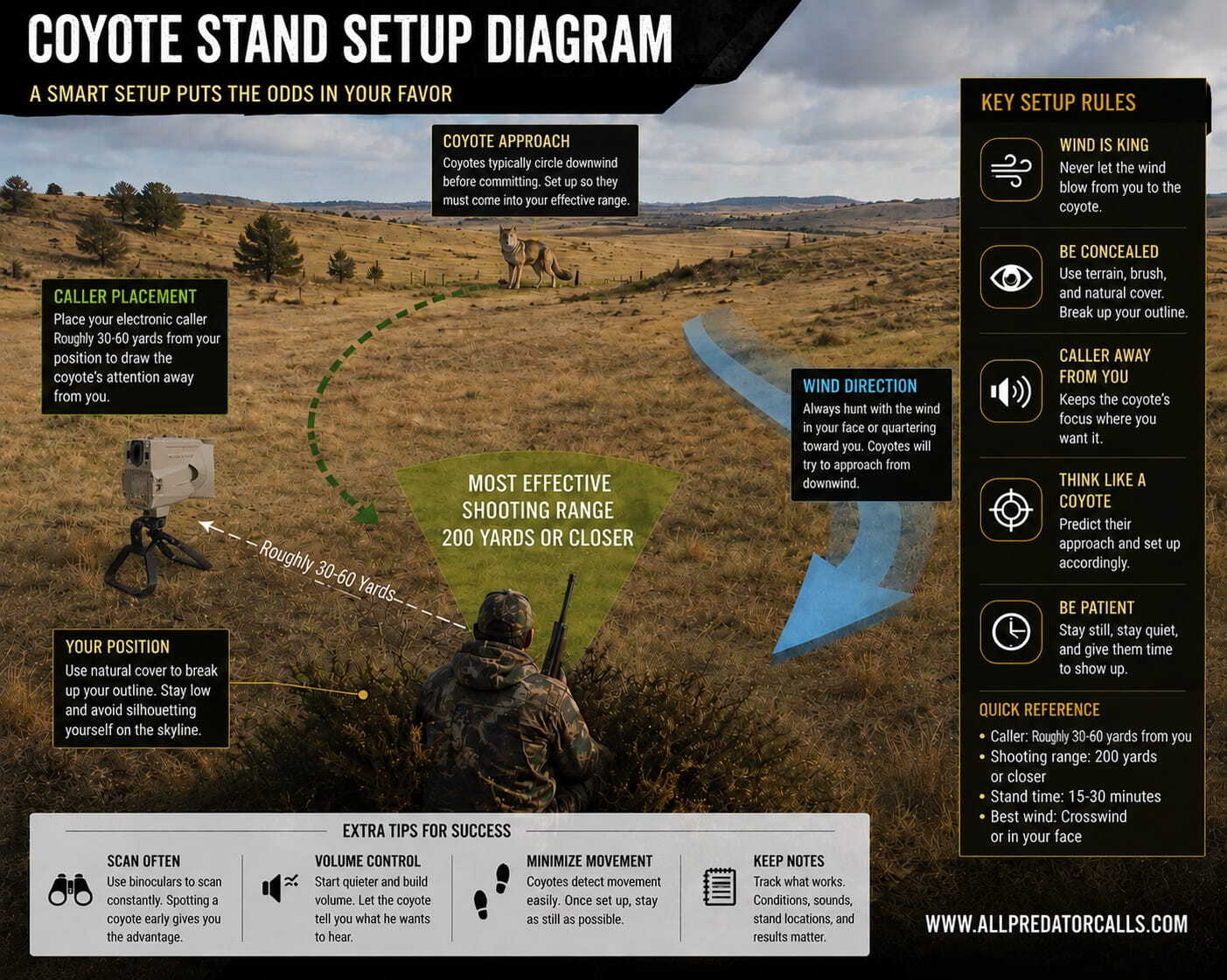
- Use a crosswind when practical: A crosswind can help the hunter watch the downwind side before a circling coyote reaches human scent.
- Keep likely approaches visible: Watch draws, washes, fence lines, brush edges, saddles, creek bottoms, and terrain folds.
- Avoid skylining: Stay below exposed ridges and use brush, shadows, rocks, or terrain behind you to break up your outline.
- Plan the entry route: Avoid walking through the area where coyotes are likely bedding, traveling, or approaching the caller.
- Prepare before calling: Position the caller, support, seat, firearm, remote, and other equipment before starting the sequence.
- Place the sound strategically: In many daylight setups, an electronic caller is placed away from the hunter so approaching coyotes focus on the sound source.
- Adapt to the terrain: Open country favors long visibility, while brush and timber may require tighter setups and faster reaction.
A coyote may remain hidden while circling through brush, timber, a wash, or a terrain depression. A setup that offers no view of the downwind side can fail without the hunter ever seeing the animal.
Both electronic callers and mouth calls can call coyotes effectively. The right choice depends on the hunter’s experience, terrain, mobility, desired sound variety, and need to place the sound away from the shooting position.
Electronic Call Advantages
- Place the sound source away from the hunter.
- Reduce movement while the sound is playing.
- Provide consistent sound reproduction.
- Offer multiple prey sounds and coyote vocalizations.
- Allow remote volume and sound changes.
- Can pair with a separate or integrated motion decoy.
Mouth Call Advantages
- Lightweight and easy to carry.
- Require no batteries or remote.
- Allow natural changes in pitch, emotion, and cadence.
- Work well as backups or finishing sounds.
- Can be effective when coyotes have heard common recordings.
Beginners who want simple operation may start with an electronic caller or a closed-reed mouth call. Hunters who practice regularly may add open-reed calls, howlers, or a combination of electronic and mouth calling.
Learn How to Choose the Right Predator Call → Compare Electronic Calls and Mouth Calls → Learn Electronic Calling Fundamentals → Learn Mouth Calling Fundamentals → Learn How to Call Coyotes with Electronic Calls → Learn How to Call Coyotes with Mouth Calls →Coyotes may respond to prey distress, social vocalizations, territorial sounds, breeding vocalizations, pup distress, or subtle coaxing sounds. There is no single sound that is always best, so sound selection should match the season, terrain, pressure, and likely motivation of nearby coyotes.
Useful Beginner Sound Categories
- Rabbit distress: A dependable starting category that can produce responses throughout much of the year.
- Rodent and bird distress: Useful for subtle calling, pressured coyotes, and close-range finishing situations.
- Lone and interrogation howls: Can locate coyotes or trigger social and territorial interest.
- Female invitation sounds: Often associated with winter breeding-season calling.
- Challenge vocalizations: Can trigger territorial responses but should be used with an understanding of the situation.
- Pup distress: Can create protective, social, territorial, or curiosity-driven responses and is often used after a shot.
Volume and Cadence
Call volume should account for wind, terrain, distance, and how close coyotes may already be. A quiet opening can avoid overwhelming a nearby coyote, while open country or strong wind may require more volume.
Some sequences use continuous calling, while others include silent pauses. Both approaches can work. The important goal is to create a believable sequence without allowing remote changes or unnecessary movement to distract the hunter from watching the stand.
Beginners often benefit from starting with one believable prey-distress sound instead of rapidly cycling through a large sound library. Add or change sounds when the stand conditions give you a reason to do so.
Many coyotes respond within the first several minutes, but stand duration should reflect terrain, visibility, coyote density, wind, hunting pressure, and the distance an animal may need to travel.
- Open country: Longer visibility may reveal coyotes approaching from a considerable distance.
- Thick cover: Coyotes may be close but remain hidden while approaching slowly through brush or timber.
- Pressured areas: Educated coyotes may stop, circle, or take longer to evaluate the sound.
- Poor wind: Staying longer will not repair a setup where human scent is entering the expected approach route.
- Strong coyote sign: A high-confidence location may justify more patience than a speculative stand.
When ending the stand, stop calling, watch quietly for a few additional minutes, and scan the downwind side before standing. Coyotes sometimes appear during the final silent period.
Learn How Long to Stay on a Predator Stand → Learn When to Move to Another Stand → Plan How Many Stands to Make per Day → Maximize Predator Hunting Stand Efficiency → Learn How to Leave a Stand Quietly →Calling a coyote into view is where movement control, preparation, and patience become especially important. Coyotes may charge directly toward the caller, stop at a distance, use cover, or begin circling downwind.
- Stay still: Avoid sudden movement toward the firearm, remote, or shooting support.
- Watch its body language: A committed coyote behaves differently from one that is suspicious, looking downwind, or preparing to leave.
- Let it enter a better position: Do not rush unnecessary movement when the coyote is naturally approaching a clear shooting lane.
- Stop a moving coyote when needed: A bark, whistle, or lip squeak may briefly stop the animal for a controlled opportunity.
- Expect additional coyotes: Pairs and family groups can produce more than one response on the same stand.
- Reload and remain ready: Do not assume the stand is finished immediately after the first shot.
When a Coyote Hangs Up
A coyote that stops outside comfortable range may be evaluating the sound, looking for movement, checking the downwind side, or reacting to hunting pressure. Depending on its behavior, a hunter may lower the volume, switch to a subtle sound, add visual movement, or remain completely silent.
Pup distress can sometimes stop a departing coyote or trigger another nearby coyote. Continue watching the complete stand before standing or walking toward the first animal.
Coyote behavior changes throughout the year as young coyotes disperse, food sources shift, breeding activity increases, and adults begin raising and protecting pups. Adapting sound selection and stand location to these changes can improve consistency.
Fall
Young coyotes are often dispersing and learning to hunt independently. Prey-distress sounds can be especially productive, and early fall is often considered a favorable period for beginners.
Winter and Breeding Season
Cold weather, food demand, territorial behavior, and breeding activity can increase coyote movement and make social or breeding vocalizations more relevant.
Spring and Denning Season
Territorial and protective behavior can become important as coyotes establish denning areas and begin caring for pups. Hunters should also consider local seasons, regulations, and personal wildlife-management goals.
Summer and Pup Season
Heat often shifts movement toward early morning, evening, and nighttime. Pup distress, prey sounds, water sources, and areas near core family territories may become important.
Read the Seasonal Coyote Calling Guide → Study Coyote Hunting by Season → Learn Early-Season Coyote Hunting Tactics → Learn Breeding-Season Coyote Hunting → Learn Pup-Season Coyote Hunting → Learn How to Hunt Coyotes in Summer → Learn Winter Coyote Hunting Strategies →Terrain affects visibility, sound travel, wind, entry routes, shooting distance, and how coyotes approach. The same stand strategy should not be used in every landscape.
Open Country
- Use terrain folds and brush to avoid being skylined.
- Expect longer approaches and potentially longer shots.
- Use enough volume to reach distant coyotes.
- Watch the full downwind arc.
- Use stable shooting support.
Brush and Tight Terrain
- Expect coyotes to appear suddenly at close range.
- Use tighter shooting lanes and faster-ready positioning.
- Call at a volume appropriate for nearby animals.
- Watch openings, trails, washes, and brush edges.
- Limit movement because coyotes may be close before being seen.
Mountains and Broken Terrain
- Monitor thermals and rapidly changing wind.
- Use saddles, benches, draws, and canyon bottoms.
- Use elevation to observe likely travel routes.
- Avoid exposing yourself while crossing ridges.
- Account for sound being blocked or redirected by terrain.
Coyotes often become more active and less visible to people after dark, making night hunting productive where legal. Night stands require greater attention to target identification, safe shooting lanes, scanning technique, wind, terrain, and communication.
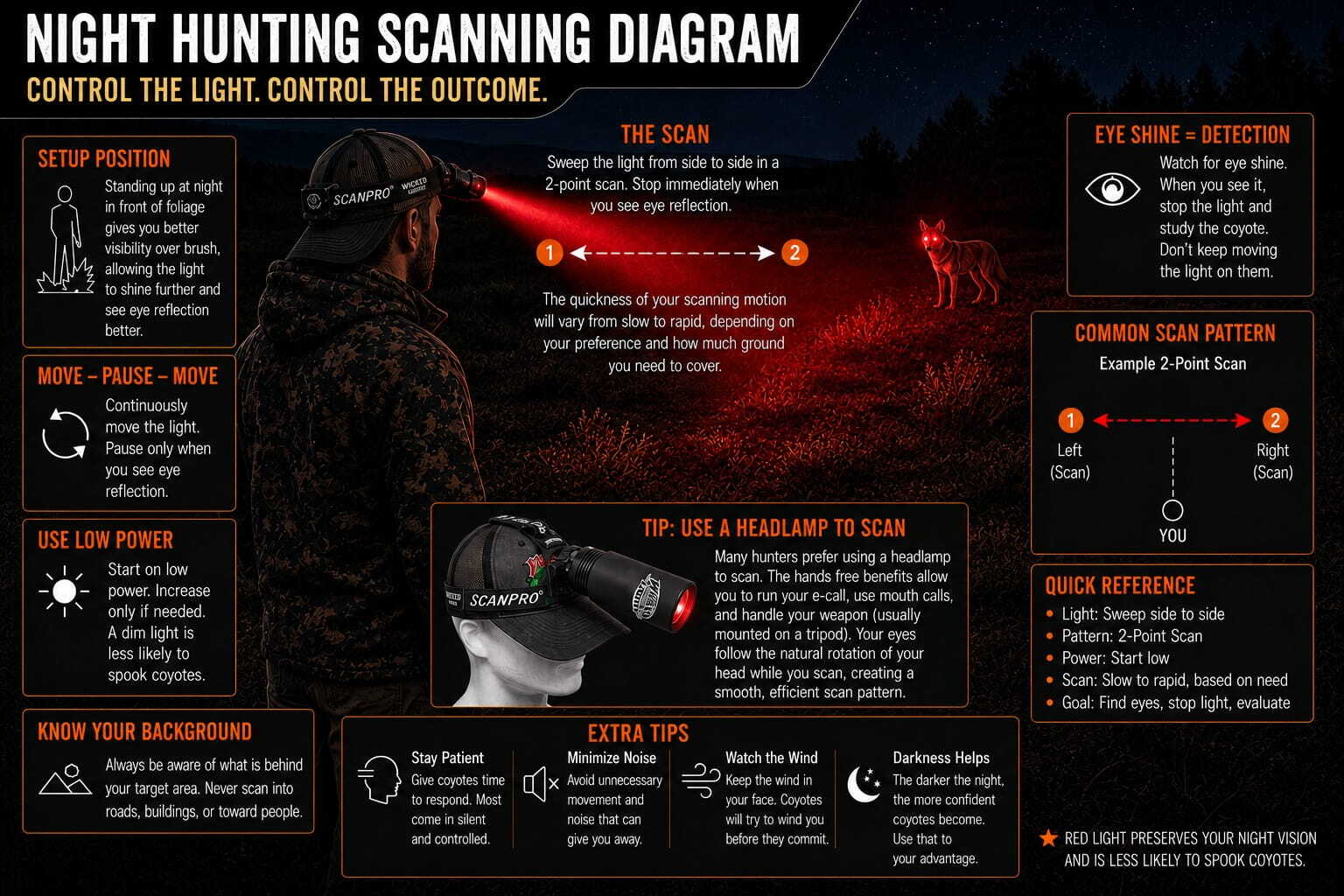
- Scout during daylight: Identify roads, livestock, buildings, fences, brush, shooting lanes, and property boundaries before dark.
- Use separate scanning and shooting systems: A scanning headlamp keeps both hands available, while a dedicated weapon-mounted light provides controlled illumination during target identification and the shot.
- Scan continuously: Coyotes can approach silently and may only be visible through reflected eyeshine.
- Stand when appropriate: Standing setups can improve visibility over brush and provide more effective scanning angles.
- Watch the downwind side: Darkness does not reduce a coyote’s ability to detect human scent.
- Confirm the target: Never shoot based only on eye reflection.
- Manage batteries: Calls, lights, thermal optics, night vision, and remotes all depend on reliable power.
A scanning headlamp follows the hunter’s vision and keeps both hands free, but a separate weapon-mounted light is needed because lowering the head into the optic directs the headlamp beam toward the ground.
Most beginners do not struggle because they lack enough equipment. They struggle because one or more basic parts of the stand allow coyotes to detect the hunter or avoid the setup.
- Calling where coyotes are not active: Scouting should come before sound selection.
- Ignoring the wind: Human scent entering an approach route can end the stand before the coyote becomes visible.
- Approaching carelessly: Vehicle noise, exposed walking, slamming doors, and talking may alert nearby coyotes.
- Moving after calling begins: Remote adjustments and unnecessary repositioning often expose the hunter.
- Calling too loudly without considering distance: Nearby coyotes may not require maximum volume.
- Changing sounds without a reason: Rapidly cycling through many sounds can distract the hunter from watching the stand.
- Leaving too early: A cautious or distant coyote may require additional time.
- Ignoring downwind cover: Coyotes may circle through terrain that hides them from view.
- Overhunting one location: Repeated pressure can make local coyotes more difficult to call.
- Standing immediately after the shot: Another coyote may still be approaching.
After the hunt, record the wind, access route, sound sequence, stand duration, coyote response, and where the animal attempted to travel. These observations help turn failed stands into useful scouting information.
Coyote hunting success comes from repeatedly applying the fundamentals in active habitat. The details change with terrain, season, pressure, and equipment, but the core process remains consistent.
- Scout for current coyote activity before hunting.
- Choose every stand around wind and visibility.
- Enter quietly without exposing the setup.
- Use realistic sounds that match the situation.
- Prepare all equipment before calling begins.
- Watch the downwind side throughout the stand.
- Remain patient when coyotes approach cautiously.
- Adapt tactics to terrain, season, and hunting pressure.
- Review every stand and keep improving.
Hunters who consistently improve scouting, setup quality, movement control, sound selection, and shot preparation usually become more successful than hunters who rely on one caller, sound, or sequence.
Continue Through the Coyote Hunting Guide →Coyote Hunting 101 FAQ
These frequently asked questions cover beginner equipment, scouting, calling sounds, electronic caller placement, wind, stand duration, hung-up coyotes, seasonal hunting, and night hunting.
A beginner needs legal and safe hunting equipment, a dependable electronic or mouth call, concealment, stable shooting support, a comfortable seat, a wind checker, and access to an area with active coyotes.
Look for fresh tracks, scat, prey activity, water, livestock or agricultural food sources, secure bedding cover, and travel corridors such as washes, draws, fence lines, field edges, and creek bottoms.
Rabbit distress is a dependable starting sound. Rodent distress, bird distress, pup distress, lone howls, and other coyote vocalizations can be added as the hunter learns how season, pressure, and coyote behavior affect responses.
Electronic calls are easy to operate and place the sound away from the hunter. Closed-reed mouth calls are affordable and beginner-friendly. Both are effective, and many hunters eventually carry both.
Crosswind setups are often effective because they allow the hunter to watch the downwind side while reducing the chance that human scent enters the expected approach route before the coyote becomes visible.
Many daylight setups place the caller approximately 30–60 yards from the hunter, but the best distance depends on terrain, visibility, wind, shooting lanes, cover, and the expected direction of approach.
Many coyote stands last approximately 15–30 minutes. Longer stands may be appropriate in open country, pressured areas, low-density habitat, or locations where coyotes must travel farther to reach the caller.
Remain still and watch its behavior. Depending on the situation, lowering the volume, switching to a subtle rodent or coaxing sound, using a mouth call, adding a silent pause, or allowing the coyote to continue circling may help it commit.
Fall and winter are popular because young coyotes are dispersing, food demand increases, and breeding activity can improve vocal responses. Coyotes can still be called during spring and summer when tactics are adapted to denning behavior, pup season, heat, and nighttime movement.
Night hunting can be highly effective where legal because coyotes frequently become more active after dark. Safe target identification, continuous scanning, favorable wind, daylight scouting, and appropriate lighting or optics are essential.