
Bobcat Hunting 101: Complete Beginner Guide
Learn how to find, call, and hunt bobcats using proven scouting, habitat, stand setup, sound selection, decoy, concealment, and nighttime hunting strategies.
What is the basic formula for successful bobcat hunting? Find fresh bobcat sign near thick cover and prey, choose a stand with visibility into likely stalking routes, use realistic high-pitched prey sounds, add a visible motion decoy when appropriate, remain extremely still, and stay longer than you typically would on a fast-response predator stand.
Bobcat hunting is a patient form of predator hunting that rewards careful scouting, realistic prey sounds, strong visual setups, and close attention to small movements in thick terrain.
Bobcats commonly stalk instead of charging directly toward a caller. They may move slowly through brush, pause behind cover, sit motionless while observing the setup, or approach from an angle that keeps terrain between them and the hunter.
- Bobcats use cover: Brush, rim rock, timber edges, creek bottoms, canyon systems, rocky country, and broken terrain provide concealment and hunting opportunities.
- Bobcats can approach slowly: A responding cat may take considerably longer to appear than hunters expect.
- Visual attraction matters: Motion near the sound source can help a bobcat locate and commit to the setup.
- Small prey sounds work well: Cottontail, bird, woodpecker, rodent, mouse, and other higher-pitched distress sounds frequently match the prey bobcats hunt.
- Movement control is critical: A bobcat may watch the setup for an extended period before exposing itself.
Learn to identify productive bobcat habitat and remain patient on stand. Buying more sounds rarely compensates for hunting an area without active cats or leaving before a cautious bobcat arrives.
Bobcat seasons, licenses, tags, harvest reporting, legal equipment, trapping regulations, possession requirements, night hunting rules, and public-land restrictions vary by location. Verify all current regulations before hunting.
- Confirm the season and licensing rules: Bobcats may be managed differently from unprotected or year-round predator species.
- Check tagging and reporting requirements: Some jurisdictions require tags, registration, sealing, reporting, or proof of legal harvest.
- Identify the target and background: Never shoot at movement, partial visibility, or eyeshine without positive identification.
- Know property boundaries: Obtain permission where required and remain aware of nearby roads, homes, livestock, trails, and buildings.
- Use safe shooting lanes: Dense bobcat habitat can make it difficult to see what is behind the target.
- Check night hunting regulations separately: Artificial lights, thermal optics, night vision, weapons, seasons, and public-land access may have separate rules.
Bobcat regulations can involve species-specific seasons, quotas, tags, reporting, fur requirements, and equipment restrictions. Do not assume that general predator hunting rules automatically apply to bobcats.
Bobcats are stealth-oriented predators that use vegetation, rocks, shadows, elevation changes, and terrain edges to move close to prey without being detected. Productive habitat usually combines prey, security cover, travel routes, and places where a cat can observe its surroundings.
- Brush and edge cover: Bobcats commonly travel where thick vegetation meets an opening, road, field, meadow, creek, or rocky slope.
- Rocky terrain and rim rock: Ledges, boulders, cliffs, benches, and canyon walls can provide travel routes, observation points, and shelter.
- Creek and river systems: Waterways often provide prey, vegetation, tracks, and concealed travel.
- Prey-rich habitat: Rabbits, rodents, birds, and other small animals help concentrate bobcat activity.
- Broken terrain: Terrain folds, draws, washes, and small openings allow bobcats to stalk while remaining concealed.
- Human pressure: Bobcats exposed to roads, lights, callers, or repeated hunting activity may become more cautious or nocturnal.
A productive bobcat stand often overlooks the edge of secure cover rather than the center of a wide-open area. The goal is to give the hunter enough visibility while allowing the cat to feel secure during its approach.
Learn How to Identify Bobcat Habitat → Study Bobcat Behavior → Learn How Terrain Changes Predator Hunting → Learn Where Predators Commonly Travel → Identify Predator Travel Corridors →Scouting helps determine whether bobcats are currently using an area and where they are most likely to travel. Because bobcats can exist at lower densities and leave less obvious evidence than some predators, hunters should evaluate multiple forms of sign.
- Look for tracks: Mud, snow, sand, dusty roads, creek crossings, washes, and trail edges commonly preserve tracks.
- Find scat and scent-marking areas: Bobcats may leave scat near trails, scrapes, junctions, ledges, or other prominent travel locations.
- Search for travel corridors: Creek bottoms, rim-rock edges, saddles, brush lines, logging roads, rocky benches, and canyon routes can funnel movement.
- Identify prey concentration: Rabbit cover, rodent activity, bird habitat, water, and edge terrain can help reveal productive areas.
- Use trail cameras where legal: Cameras can confirm activity, travel direction, and time of movement without repeatedly entering the area.
- Study maps before entering: Aerial imagery can reveal access routes, terrain edges, small openings, drainages, rocky features, and stand locations.
One old track does not prove a bobcat is using the area today. Combine tracks, scat, prey, trail-camera activity, and suitable habitat before committing significant time to a location.
Bobcat hunters benefit from lightweight, dependable gear that supports long stands, precise sound placement, visual attraction, concealment, and careful observation in broken or brushy terrain.
- Bobcat calls : Mouth calls designed for rabbit, bird, rodent, and other small-prey distress sounds provide a portable calling option.
- Electronic predator calls : Allow continuous calling, remote operation, realistic sound libraries, and placement away from the hunter.
- Custom FOXPRO calls : Custom programming can organize bobcat sounds, prey distress, coaxing sounds, and calling sequences for faster access in the field.
- Predator decoys : Motion near the sound source helps provide visual confirmation and focuses the cat away from the hunter.
- Sticks & tripods : Improve stability and allow the hunter to remain ready through a long, slow approach.
- Seats & stools : Improve comfort, body position, visibility, and movement control during extended stands.
- Camouflage and concealment : Help break up the hunter’s outline while a bobcat pauses and studies the setup.
- Camouflage gloves : Conceal hand movement while operating a remote or repositioning on shooting support.
- Head nets and face covers : Reduce exposed-skin contrast and visible facial movement.
- Night hunting lights : Support scanning and positive identification after dark where legal.
The best bobcat setup is not necessarily the most expensive. It is the setup that can be carried quietly into productive habitat, operated without excessive movement, and used comfortably for a longer stand.
Build a Beginner Predator Hunting Setup → Build Your First Predator Hunting Kit → Explore the Best Gear for Bobcat Hunting → Learn How Much Predator Hunting Gear You Need →Electronic callers and mouth calls can both call bobcats. Many hunters choose electronic calls for continuous sound and remote placement, while mouth calls provide portability, natural variation, and subtle finishing sounds.
Electronic Call Advantages
- Place sound and motion away from the hunter.
- Play long or continuous distress sequences.
- Reduce visible hand and head movement.
- Provide bird, rabbit, rodent, and coaxing sounds.
- Allow remote volume and sound control.
- Pair easily with a decoy near the sound source.
Mouth Call Advantages
- Lightweight and easy to carry in rough terrain.
- Require no batteries, speaker, or remote.
- Allow immediate changes in pitch and intensity.
- Work well for subtle close-range coaxing.
- Provide backup if an electronic caller loses power.
A simple beginner setup might use an electronic caller with several small-prey sounds and one dependable bobcat mouth call as a backup or finishing call.
Compare Electronic Calls and Mouth Calls → Learn Electronic Calling Fundamentals → Learn Mouth Calling Fundamentals → Compare Electronic Calls for Bobcats → Compare Electronic Calls for Heavy Cover → Compare Mouth Calls for Bobcats → Compare Mouth Calls for Heavy Cover → Learn How to Call Bobcats with Electronic Calls → Learn How to Call Bobcats with Mouth Calls →Bobcats commonly respond to prey sounds associated with rabbits, rodents, birds, and other small animals. Higher pitches can travel through cover and may create the struggling-prey impression that attracts a hunting cat.
Useful Bobcat Sound Categories
- Cottontail distress: A dependable rabbit sound for many bobcat habitats.
- Bird distress: High-pitched bird sounds can trigger curiosity and predatory interest.
- Woodpecker distress: A sharp, high-pitched sound that is often associated with bobcat calling.
- Rodent, mouse, and vole sounds: Useful for realistic small-prey sequences and cautious cats approaching at close range.
- Bobcat vocalizations: Can be useful in specific social, territorial, breeding, or curiosity-driven situations.
Continuous Calling vs Pauses
Continuous prey distress is popular for bobcats because it gives a slowly approaching cat a consistent sound to follow. Pauses can also work, particularly when changing the mood of the sequence or listening and watching for nearby movement.
Volume
Match volume to terrain and distance. Thick cover may hold bobcats close to the stand, while wind, large canyons, or broken open terrain may require more projection. Excessive volume is not automatically more effective.
Start with a realistic prey sound and allow it enough time to work. Rapidly changing through many unrelated sounds can distract the hunter from watching for the subtle movement of an approaching cat.
A productive bobcat stand combines visibility, concealment, favorable wind, and a sound-and-decoy location that encourages the cat to enter a controlled opening.
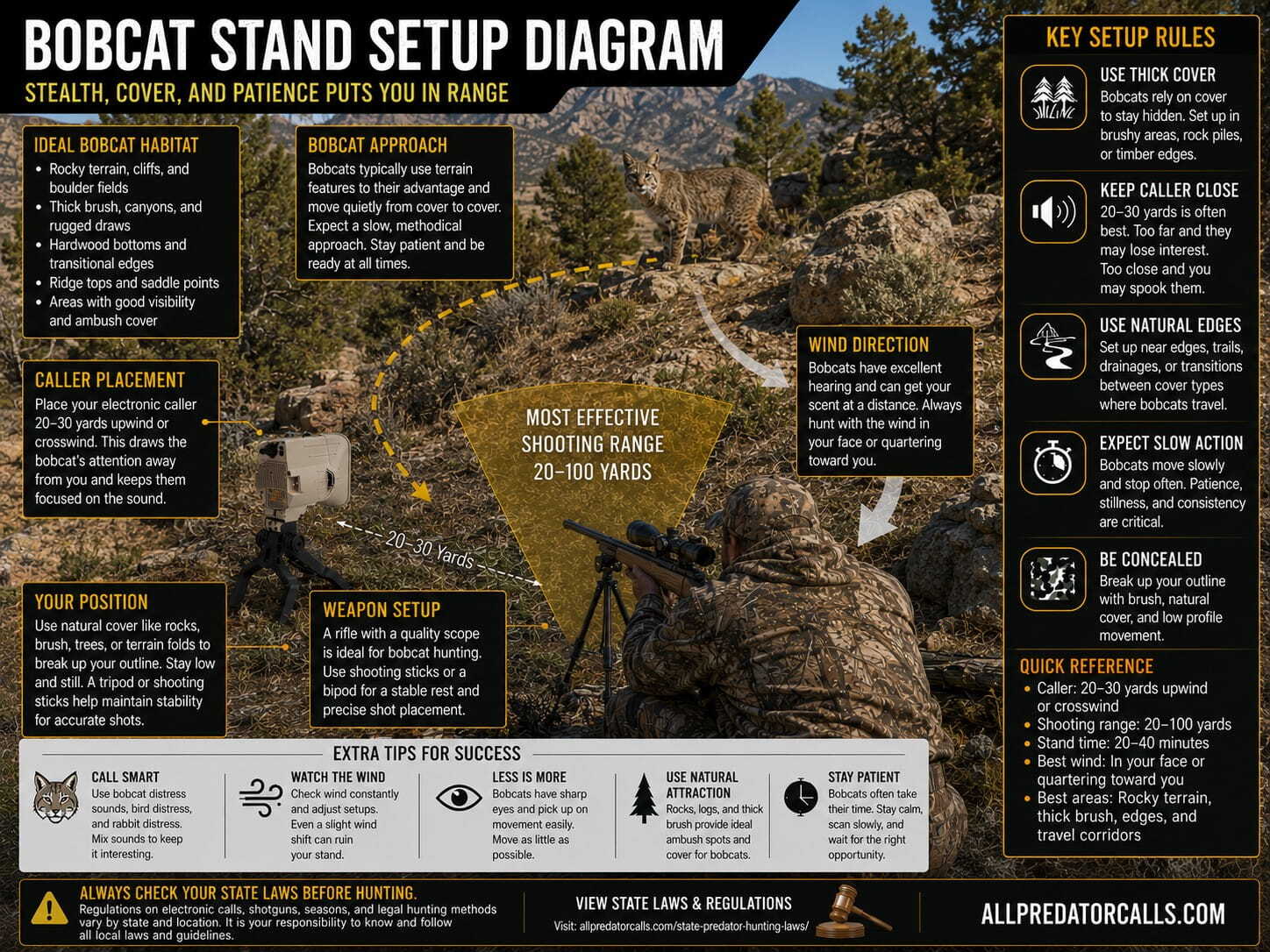
- Watch cover edges: Bobcats may travel inside vegetation before appearing at an opening.
- Use slight elevation when practical: A small rise can improve visibility into brush, washes, creek bottoms, and rocky terrain.
- Keep the wind favorable: Bobcats use scent while investigating a setup even though they are often discussed as visually oriented predators.
- Position the caller away from the hunter: This directs attention toward the sound source and can improve shot positioning.
- Place the decoy where it can be seen: A motion decoy hidden in thick vegetation provides little visual benefit.
- Use a controlled opening: Small openings near cover can encourage the cat to expose itself without requiring it to cross a large open area.
- Prepare before calling: Position the caller, decoy, seat, support, remote, and other equipment before the sequence begins.
A bobcat may sit in cover and observe the decoy without approaching it. Continue watching brush edges, rocks, shadows, trails, and elevated positions around the entire setup.
Bobcat stands commonly require more patience than fast-response predator stands. A cat may begin approaching quickly but still take considerable time to stalk through cover, stop, observe, and enter the opening.
- Plan for longer stands: Many bobcat hunters remain for approximately 30–45 minutes, and some situations justify additional time.
- Thick cover hides movement: A bobcat may be close without being visible.
- Low-density areas require patience: Cats may need to travel farther to reach the sound.
- Hunting pressure can slow commitment: A cautious cat may stop repeatedly or observe from cover.
- Cold, wind, and terrain affect travel time: Conditions can change how quickly a cat reaches the stand.
When ending the stand, stop calling and remain still for a final observation period. Carefully scan the sound source, decoy, downwind side, nearby rocks, and cover edges before standing.
A bobcat may become visible after the sound stops because it continues toward the last known location or moves to a better observation point.
Bobcats can be hunted during legal seasons, but prey availability, vegetation, breeding behavior, weather, and hunting pressure can change where they travel and how they respond.
Early Season
Thick vegetation can reduce visibility and keep approaching cats hidden. Focus on small openings, roads, creek crossings, and terrain edges where movement can be detected.
Cold Weather
Reduced vegetation, snow, and concentrated prey can improve tracking and visibility. Fresh snow may reveal travel routes, tracks, and current activity.
Breeding Season
Bobcat movement and social interest may change during breeding periods. Vocalizations can become more relevant, but realistic prey distress remains a dependable foundation.
Denning and Kitten-Rearing Periods
Movement, home-range use, and food demands can shift around denning and kitten-rearing activity. Hunters should always follow local season structures and wildlife-management rules.
Learn How Predator Hunting Changes by Season → Understand Bobcat Breeding Season → Understand Bobcat Denning Behavior → Match Predator Sounds to Weather Conditions → Match Sounds to Hunting Pressure →Night hunting can be productive for bobcats because cats commonly move and hunt after dark. Success depends on legal equipment, continuous scanning, target identification, favorable wind, safe shooting lanes, and careful observation around cover.
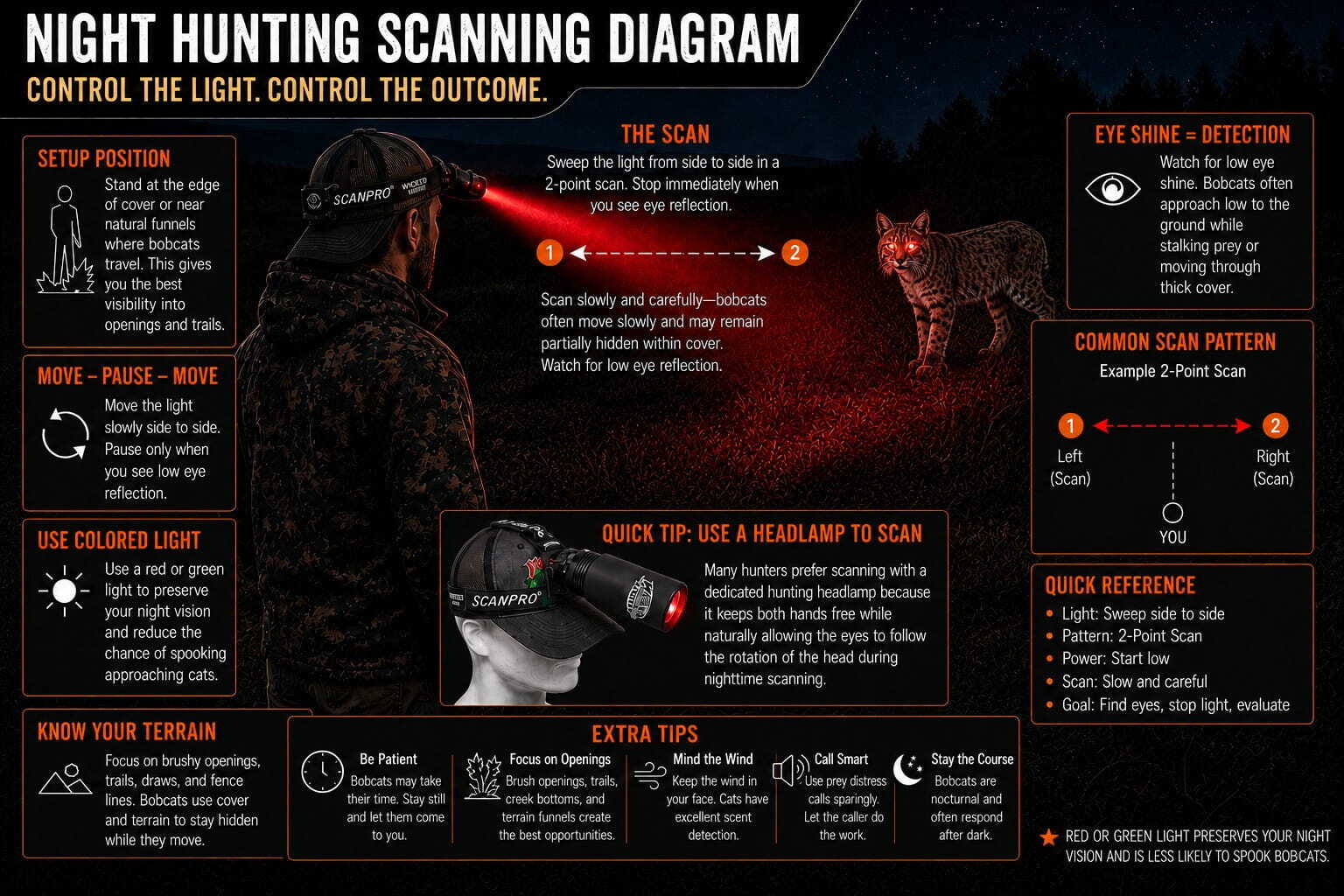
- Scout during daylight: Identify roads, fences, livestock, brush, rocks, shooting lanes, and property boundaries before dark.
- Scan slowly and continuously: Bobcats may move slowly, crouch low, or remain motionless near cover.
- Watch for low eyeshine: Cats often approach close to the ground while stalking.
- Use a hands-free scanning headlamp: A dedicated headlamp allows the eyes to follow natural head movement while keeping both hands available.
- Use a separate weapon-mounted light: A headlamp is for scanning. Lowering the head into an optic directs the headlamp beam toward the ground, so a dedicated weapon light is needed for identification and the shot.
- Stand when terrain requires it: Standing can improve scanning visibility over brush and broken ground.
- Confirm the target: Never shoot based only on eyeshine.
- Manage batteries: Callers, remotes, lights, thermal optics, and night vision require dependable power.
Bobcats may remain at the edge of the beam, behind brush, or near a rock while watching the setup. Continue scanning likely approach routes even when the decoy and caller are fully visible.
Most unsuccessful bobcat stands result from location, visibility, patience, movement, sound placement, or observation problems rather than a lack of expensive gear.
- Hunting without current sign: Suitable habitat does not automatically mean a bobcat is currently using the location.
- Leaving too early: A responding cat may still be stalking through cover.
- Watching only the decoy: Bobcats may stop outside the opening and observe from brush, rocks, or shadows.
- Moving during the approach: A slow-moving bobcat may have more time to detect the hunter than a fast-charging predator.
- Hiding the decoy: Motion cannot attract a bobcat if terrain or vegetation blocks the view.
- Using poor caller placement: A caller that draws the cat directly toward the hunter may create unnecessary detection risk.
- Calling too loudly for tight cover: Nearby cats may not require maximum volume.
- Ignoring wind: Visual attraction does not eliminate the need for scent awareness.
- Failing to scan elevated locations: Bobcats may use rocks, banks, ledges, logs, or terrain rises as observation points.
- Overhunting one location: Repeated disturbance can reduce daytime activity or make local cats more cautious.
Record the wind, access route, caller and decoy position, sound sequence, stand duration, visibility, and any observed tracks or movement. These details help improve future setups even when no bobcat is seen.
Consistent bobcat hunting success comes from putting realistic sounds and visible movement near active habitat, then remaining patient enough to detect a cautious approach.
- Scout for current bobcat activity before hunting.
- Focus on prey-rich cover and travel corridors.
- Use realistic rabbit, bird, and rodent distress sounds.
- Place callers and decoys away from the hunter.
- Make decoy movement visible from likely approach routes.
- Watch cover edges, rocks, shadows, and elevated positions.
- Remain still throughout the stand.
- Allow enough time for a slow approach.
- Adapt volume and sound choice to terrain and pressure.
- Learn from every track, sighting, and unsuccessful stand.
Hunters who improve habitat selection, patience, visual awareness, and stand design generally become more consistent than hunters who rely on a single sound or piece of equipment.
Continue Through the Bobcat Hunting Guide →Bobcat Hunting 101 FAQ
These frequently asked questions cover bobcat habitat, scouting, calling sounds, electronic and mouth calls, decoys, stand duration, caller placement, seasonal activity, and night hunting.
A beginner needs a dependable electronic or mouth call, camouflage, stable shooting support, a comfortable seat, and access to active bobcat habitat. A visible motion decoy is also highly useful because bobcats often look for visual confirmation near the sound source.
Cottontail distress, bird distress, woodpecker distress, rodent distress, mouse sounds, and other high-pitched small-prey sounds are dependable choices. Bobcat vocalizations may also be useful in specific social, territorial, or breeding situations.
Look for fresh tracks, scat, prey activity, creek bottoms, rocky terrain, rim rock, brush edges, canyon systems, logging roads, washes, and other travel corridors that combine prey with secure stalking cover.
Both can be effective. Electronic calls provide continuous sound, remote operation, and placement away from the hunter. Mouth calls are lightweight, battery-free, and useful for natural sound variation or close-range coaxing. Many hunters carry both.
Yes. A visible motion decoy gives the bobcat something to stalk, helps confirm the location of the sound, and can focus the cat’s attention away from the hunter. The decoy should be placed where approaching cats can see it from likely travel routes.
Continuous prey distress often works well because it gives a slowly approaching bobcat a consistent sound to follow. Silent pauses can also be effective, especially when changing the sequence or watching for a cat that has moved close to the setup.
Many bobcat hunters stay approximately 30–45 minutes, and longer stands may be appropriate in thick cover, low-density habitat, pressured areas, or locations where a cat must travel farther to reach the sound.
The best distance depends on terrain, visibility, wind, cover, and shooting lanes. The caller and decoy should be far enough away to direct the bobcat’s attention from the hunter but close enough to remain visible and within a safe, controlled shooting area.
Early morning, late evening, and nighttime can be productive because bobcats often move during lower-light periods. Daytime calling can still work when hunters focus on secure cover, current sign, favorable weather, and productive travel routes.
Night hunting can be highly effective where legal because bobcats commonly move and hunt after dark. Continuous scanning, positive target identification, favorable wind, daylight scouting, and separate scanning and weapon-mounted lights are important for safe and effective night stands.