
Bobcat Stand Setup & Wind Strategy
Learn how to choose productive bobcat stand locations, use wind effectively, position callers and decoys, and create high-percentage setups that consistently produce more bobcat encounters.
What Is The Best Stand Setup For Bobcat Hunting?
The best bobcat stand setups typically use crosswinds, focus on natural travel routes, provide clear shooting lanes, position callers away from the hunter, and take advantage of terrain features that naturally funnel bobcat movement.
- Use crosswinds whenever possible.
- Set up near likely travel corridors.
- Utilize terrain funnels.
- Place callers away from the hunter.
- Use visual decoys.
- Prepare shooting lanes before calling.
Unlike coyotes, bobcats often approach slowly and cautiously, making patience and stand selection especially important.
Why Stand Setup Matters More Than Calling
Many hunters focus heavily on sounds while overlooking the importance of stand placement. In reality, stand setup frequently determines whether a bobcat is seen at all.
Proper setup influences:
- How bobcats approach.
- Visibility.
- Shot opportunities.
- Detection risk.
- Wind management.
- Overall success rates.
Successful bobcat hunters typically build stands around likely travel routes and terrain features rather than simply choosing a convenient calling location.
How Bobcats Use Wind Differently Than Coyotes
One of the most common mistakes hunters make is assuming bobcats approach calls the same way coyotes do.
| Behavior | Bobcat | Coyote |
|---|---|---|
| Reliance On Scent | Moderate | Very High |
| Reliance On Vision | Very High | Moderate |
| Downwind Circling | Less Common | Very Common |
| Approach Speed | Slow | Often Fast |
| Use Of Terrain | Very High | Moderate |
Bobcats often rely heavily on vision, hearing, terrain, and cover. While wind still matters, many bobcats approach calls without making the large downwind circles commonly seen with coyotes.
Understanding Bobcat Wind Strategy
Wind remains important for bobcat hunting, but hunters should avoid thinking of bobcats as miniature coyotes. Bobcats frequently use terrain, cover, and visual stalking behavior to investigate sounds.
Productive wind strategies typically:
- Use crosswinds.
- Provide visibility into likely travel routes.
- Protect major scent paths.
- Force movement through shooting lanes.
- Utilize terrain funnels.
Visibility is often just as important as scent control when hunting bobcats.
Why Crosswind Setups Work So Well For Bobcats
Crosswind setups provide an excellent balance between scent management and visibility while allowing hunters to monitor likely approach routes.
Because bobcats often use terrain features, ridges, draws, brush lines, and rocky cover while approaching, crosswind setups frequently provide the best opportunity to intercept movement before the animal reaches the caller.
Learn more in: Crosswind Ambush Setups .
Understanding Bobcat Travel Corridors
Bobcats rarely move randomly across a landscape. Most movement occurs along predictable terrain features that provide cover, concealment, and hunting opportunities.
Common bobcat travel corridors include:
- Dry washes.
- Creek bottoms.
- Rocky draws.
- Brush lines.
- Logging roads.
- Fence lines.
- Ridge systems.
Related guide: How To Scout For Bobcats
Choosing The Right Stand Location
High-percentage bobcat stands often overlook terrain features that naturally funnel movement while providing visibility into likely approach routes.
Productive locations include:
- Draw intersections.
- Rocky hillsides.
- Creek crossings.
- Brushy openings.
- Ridge saddles.
- Travel funnels.
Related guide: Bobcat Habitat Guide
Approach Routes & Stand Entry
Bobcats often spend time near the same cover features hunters are targeting, making stand entry especially important.
- Use terrain for concealment.
- Avoid skyline exposure.
- Minimize noise.
- Avoid contaminating likely approach routes.
- Enter stands quietly and efficiently.
Alerting a nearby bobcat before calling begins can dramatically reduce the effectiveness of a stand.
Electronic Caller Placement
Electronic callers help focus attention away from the hunter while encouraging bobcats to enter visible shooting lanes.
A common setup places the caller:
- 20-50 yards from the shooter.
- Crosswind of the hunter.
- Near likely travel routes.
- Within clear visibility.
Learn more in:
Decoy Placement
Few predators respond to visual decoys as consistently as bobcats. Motion often helps maintain interest and encourages continued approach.
Most decoys perform best when positioned:
- Near the electronic caller.
- Inside visible openings.
- Within shooting range.
- Where movement can easily be seen.
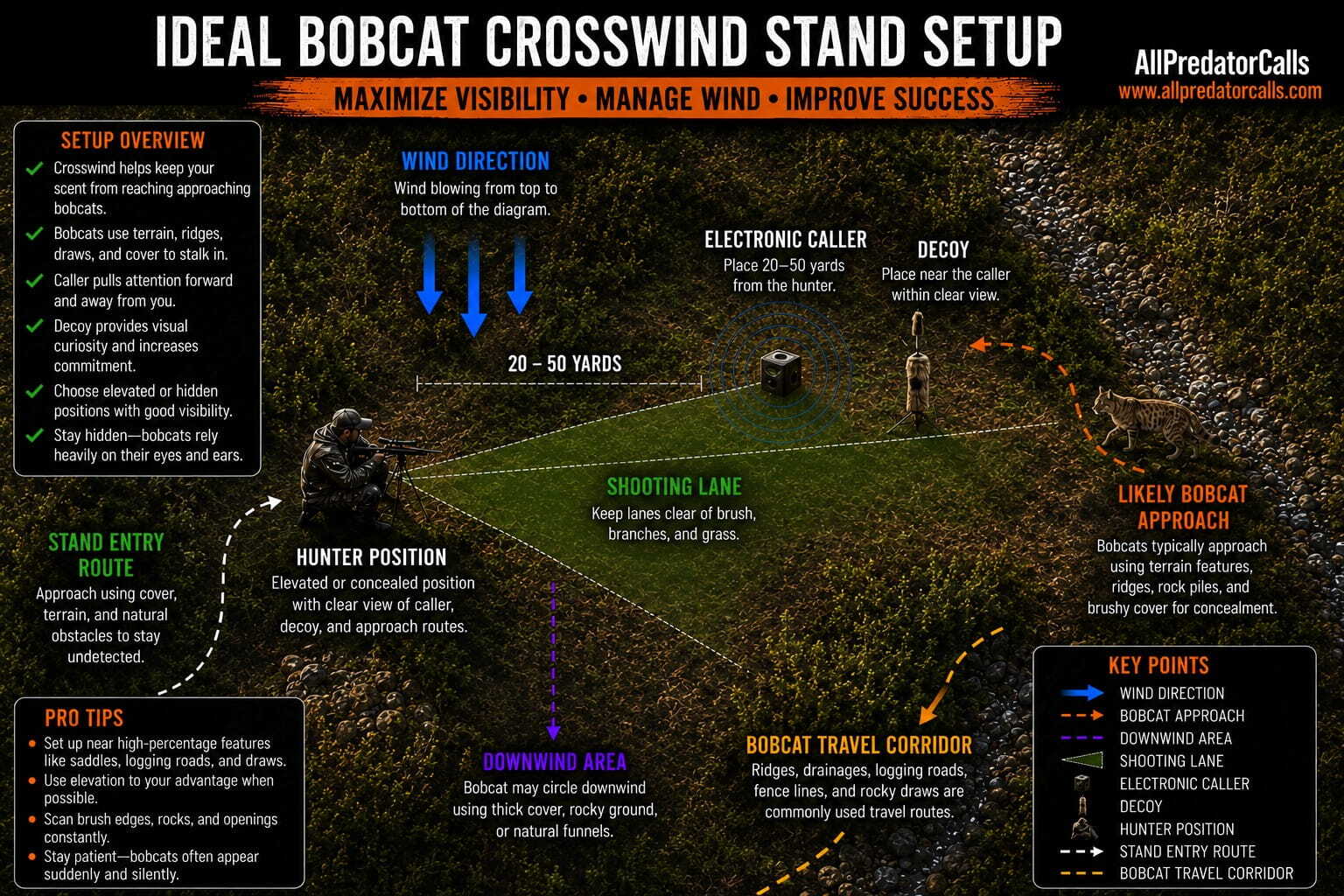
Ideal Bobcat Crosswind Stand Setup Diagram
The diagram below illustrates an effective bobcat crosswind setup featuring travel corridors, terrain funnels, caller placement, wind direction, shooting lanes, and likely bobcat approach routes.
Why Bobcat Stands Often Need More Time
One of the biggest differences between bobcats and other predators is how slowly bobcats often approach a call.
Bobcats commonly:
- Stop repeatedly.
- Sit and observe.
- Use cover extensively.
- Approach slowly.
- Remain hidden for long periods.
Many hunters leave a stand before a bobcat ever becomes visible. Patience is often one of the most important factors in successful bobcat hunting.
Learn more in: How Long To Stay On Stand For Bobcats
Daytime Bobcat Stand Setup Strategies
Daytime bobcat setups often focus on terrain features that provide visibility while still allowing bobcats to feel secure during their approach.
Productive daytime setups frequently include:
- Brushy openings.
- Rocky hillsides.
- Creek crossings.
- Travel funnels.
- Ridge systems.
Because bobcats frequently appear at close range, hunters should minimize movement and maintain constant awareness of likely approach routes.
Comfortable Seats & Stools can help hunters remain motionless during longer stands.
Night Hunting Stand Setup Strategies
Bobcats are highly active after dark, making nighttime one of the most productive periods for targeting them.
Effective night setups often emphasize:
- Visibility into likely travel corridors.
- Stable shooting support.
- Efficient scanning coverage.
- Clear shooting lanes.
- Wind awareness.
Bobcats may appear suddenly and silently, making visibility and readiness especially important after dark.
Bobcat Stand Setups For Hunting Lights
Hunting lights remain highly effective for locating and identifying bobcats during nighttime hunts.
Productive light-hunting setups often focus on:
- Travel corridors.
- Rocky draws.
- Brush edges.
- Creek bottoms.
- Openings adjacent to cover.
Learn more in:
Bobcat Stand Setups For Night Vision
Night vision equipment allows hunters to monitor likely travel routes while maintaining concealment.
Effective night vision setups often focus on:
- Creek crossings.
- Brushy funnels.
- Logging roads.
- Rocky draws.
Learn more in:
Bobcat Stand Setups For Thermal Hunting
Thermal optics can reveal bobcats hidden in vegetation, brush, and terrain features long before they become visible to the naked eye.
However, proper stand placement remains critical because thermal detection alone does not guarantee a shot opportunity.
Learn more in:
Tripods vs Shooting Sticks For Bobcat Hunting
Both systems can be effective depending on hunting style, terrain, and visibility requirements.
| Equipment | Best Use |
|---|---|
| Shooting Sticks | Daytime seated hunting |
| Tripods | Night hunting and standing shots |
Explore:
Common Bobcat Stand Setup Mistakes
- Leaving stands too early.
- Ignoring travel corridors.
- Poor caller placement.
- Insufficient visibility.
- Too much movement.
- Poor stand entry routes.
- Failing to prepare shooting lanes.
Eliminating these mistakes often improves success more than changing sounds or equipment.
Recommended Bobcat Hunting Gear
Bobcat Calls
Shop Bobcat CallsElectronic Calls
Shop Electronic CallsPredator Decoys
Shop Predator DecoysSeats & Stools
Shop Seats & StoolsShooting Sticks & Tripods
Shop Shooting SupportsCustom FOXPROs
Explore Custom FOXPROsBobcat Stand Setup & Wind Strategy FAQ
Crosswind setups near travel corridors, terrain funnels, and cover features are often the most productive.
Not usually. Bobcats often rely more heavily on vision, hearing, terrain, and cover than aggressive downwind scent-checking behavior.
Yes. Crosswind setups often provide an ideal balance of scent management and visibility.
Bobcats often approach much slower than coyotes, making longer stand times beneficial in many situations.
Bobcats frequently use terrain features, brush, rocky cover, creek bottoms, draws, and other natural concealment while approaching a call. Their slow, cautious stalking behavior often allows them to remain hidden until they are very close to the stand, causing many hunters to spot them only at the last moment.
Most hunters position electronic callers approximately 20 to 50 yards from the shooter depending on terrain and visibility.
Yes. Bobcats often respond exceptionally well to motion decoys because they rely heavily on visual cues.
Yes. Alerting a nearby bobcat during stand entry can significantly reduce the effectiveness of a setup.