
How To Scout For Bobcats
Learn how to scout for bobcats by identifying tracks, sign, rabbit concentrations, travel corridors, ambush locations, bedding cover, terrain funnels, and habitat features that consistently hold bobcats throughout the year.
What Is The Best Way To Scout For Bobcats?
The best way to scout for bobcats is to locate quality habitat, identify rabbit concentrations, find tracks and sign, locate travel corridors, and focus on terrain features that allow bobcats to hunt and ambush prey effectively.
- Find rabbit-rich habitat
- Locate fresh tracks and sign
- Focus on brushy travel corridors
- Scout rimrock, draws, and creek bottoms
- Use thermal and trail cameras to confirm activity
- Identify bedding and ambush locations
Successful bobcat hunters spend far more time locating cats than they do choosing sounds. Even the best calling sequence cannot consistently produce results if bobcats are not present.
Bobcats often occupy smaller areas than coyotes and can remain hidden in excellent habitat for long periods. Thorough scouting is often the difference between productive stands and empty stands.
Why Scouting Matters For Bobcat Hunting
Bobcats behave differently than coyotes, foxes, and many other predators. They rely heavily on stealth, cover, and ambush tactics. Because of this, locating active bobcat habitat before hunting is extremely important.
Scouting helps hunters:
- Locate active bobcat populations
- Find productive stand locations
- Identify rabbit concentrations
- Understand travel routes
- Locate bedding and hunting cover
- Increase calling success rates
Once bobcats are located, hunters can apply calling techniques using bobcat mouth calls , predator calls , and electronic callers.
Understanding Bobcat Habitat
Habitat is often the single biggest factor when scouting bobcats. While bobcats can occupy a variety of environments, they typically prefer areas that provide cover, prey, and opportunities to ambush animals.
Brushy Cover
Dense vegetation provides concealment and hunting opportunities.
Rimrock & Cliffs
Elevated terrain often provides security and hunting advantages.
Creek Bottoms
Water, prey, and cover combine to create excellent habitat.
Broken Terrain
Draws, canyons, and rocky country frequently hold bobcats.
Bobcats prefer locations that allow them to approach prey undetected. The best habitat typically provides both cover and visibility.
Identifying Bobcat Tracks
Tracks are one of the most reliable indicators of bobcat activity. Because bobcats are often secretive and difficult to observe directly, tracks frequently provide the first evidence that a cat is using an area.
Round Shape
Bobcat tracks are generally rounder than canine tracks.
No Claw Marks
Bobcats typically retract their claws while walking.
Roads & Trails
Dirt roads and trails often reveal fresh tracks.
Washes & Creeks
Sandy areas frequently capture track impressions.
For a deeper dive into identifying cat sign, see: Bobcat Tracks & Sign .
Using Scat & Sign To Locate Bobcats
Bobcat scat can reveal active travel routes, feeding areas, and territorial activity. Because bobcats frequently use the same travel corridors repeatedly, finding fresh sign can be extremely valuable.
Hunters should also look for:
- Scratch marks
- Fresh kills
- Feathers and fur
- Game trails
- Repeated track patterns
A single track can be helpful, but multiple forms of sign occurring together often indicate a consistently used area.
Scout Rabbit Habitat First
Few scouting strategies are more effective than locating areas with abundant rabbits. In many regions, rabbit populations directly influence bobcat distribution.
Brushy edges, overgrown fields, creek bottoms, and thick cover often support large rabbit populations and become natural bobcat hunting areas.
Brush Piles
Provide shelter for rabbits and hunting opportunities for bobcats.
Overgrown Fields
Frequently support high prey densities.
Edge Habitat
Natural transition zones used by both predators and prey.
Creek Corridors
Offer food, water, and cover in one location.
Travel Corridors & Ambush Routes
Bobcats frequently move through predictable travel corridors that connect feeding areas, bedding cover, and water sources.
Common travel corridors include:
- Creek bottoms
- Brushy fence lines
- Draws and washes
- Ridge systems
- Logging roads
- Terrain funnels
Unlike coyotes, bobcats often move slowly and deliberately through cover, using terrain features to remain concealed.
Rimrock, Cliffs & Rock Outcroppings
Rocky terrain often creates ideal bobcat habitat. Rimrock, cliffs, rock piles, and broken terrain provide bedding locations, security cover, and natural ambush positions.
In western states especially, some of the most productive bobcat hunting areas are centered around rocky terrain features.
If you find rocky terrain near rabbit habitat and cover, you have likely found high-potential bobcat country.
Creek Bottoms, Draws & Canyons
Creek bottoms and brush-filled draws often concentrate everything bobcats need: prey, cover, water, and travel routes.
These terrain features frequently become highways for bobcat movement, especially in arid regions where water sources are limited.
Using Mapping Apps & Aerial Imagery
Modern mapping applications allow hunters to identify potential bobcat habitat before ever stepping into the field.
Look for:
- Brushy creek bottoms
- Rock outcroppings
- Rimrock features
- Rabbit habitat
- Terrain funnels
- Water sources
- Travel corridors
Properties containing multiple habitat features often produce the most consistent bobcat activity.
Example: How To Identify Productive Bobcat Hunting Areas
The illustration below demonstrates how successful bobcat hunters evaluate a property before making a stand. Unlike coyotes, bobcats often focus on ambush cover, terrain funnels, rabbit concentrations, rocky structure, and protected travel routes.
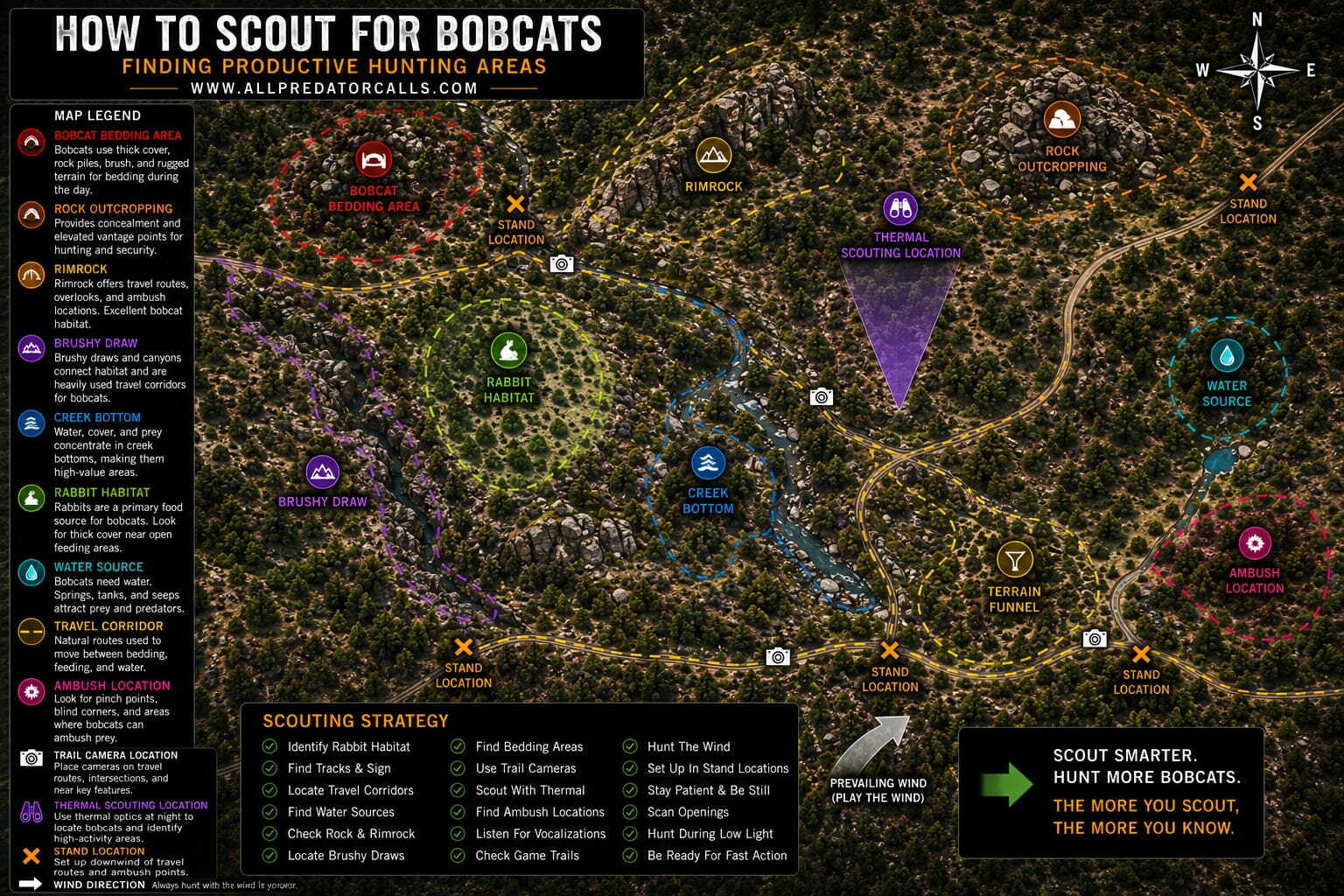
Bobcats rarely need large open areas. Instead, focus on cover, prey concentrations, and terrain features that allow a bobcat to approach prey undetected.
Using Trail Cameras To Scout Bobcats
Trail cameras can be extremely valuable for scouting bobcats because they often reveal activity that hunters would never observe during daylight hours.
Travel Corridors
Identify routes used repeatedly by bobcats.
Activity Times
Determine when bobcats are active in an area.
Population Monitoring
Confirm multiple cats are using a property.
Seasonal Patterns
Track movement changes throughout the year.
Cameras are particularly effective near creek crossings, game trails, rabbit habitat, logging roads, and terrain funnels.
Thermal Scouting For Bobcats
Modern thermal optics have become one of the most effective scouting tools available for locating bobcats after dark.
Thermal allows hunters to identify active hunting areas, rabbit concentrations, travel corridors, and bobcat movement patterns without making a calling stand.
Many hunters discover more about local bobcat populations during a single evening of thermal scouting than weeks of traditional observation.
Night Scouting With Hunting Lights
Nighttime observation using predator hunting lights can provide valuable information about bobcat activity, feeding areas, and travel routes.
Because bobcats often hunt during low-light periods and nighttime hours, after-dark scouting can be extremely productive.
Seasonal Bobcat Scouting
Spring
Focus on denning areas and family groups.
Summer
Locate water sources and prey concentrations.
Fall
Young bobcats begin expanding into new areas.
Winter
Breeding activity often increases movement patterns.
Scouting Bobcats vs Scouting Coyotes
While both predators may occupy the same general area, their habitat preferences and movement patterns often differ significantly.
| Factor | Bobcat | Coyote |
|---|---|---|
| Primary Strategy | Ambush Predator | Pursuit Predator |
| Cover Preference | Dense Cover | Varied |
| Rabbit Dependence | Very High | Moderate |
| Terrain Funnels | Extremely Important | Important |
| Movement Speed | Slow & Deliberate | Faster |
Hunters transitioning from coyotes should avoid assuming bobcats use the same terrain in the same way.
Scouting Public Land Bobcats
Public land bobcat hunting can be highly productive when hunters focus on overlooked habitat and terrain features.
- Remote canyon systems
- Brushy creek bottoms
- Rock outcroppings
- Rimrock features
- Rabbit-rich habitat
- Terrain funnels
Many productive bobcat areas receive less hunting pressure than comparable coyote locations.
Turning Scouting Information Into Productive Bobcat Stands
Once bobcat activity has been confirmed, hunters must convert that information into effective stand locations.
- Play the wind
- Maintain visibility into openings
- Use decoys whenever possible
- Focus on terrain funnels
- Be patient and stay longer on stand
- Hunt fresh sign whenever possible
Related guides:
Recommended Gear For Scouting Bobcats
Related Bobcat Hunting Guides
How To Scout For Bobcats FAQ
Focus on rabbit habitat, tracks, sign, travel corridors, terrain funnels, and thermal observation.
Bobcats generally prefer areas with cover, prey, terrain features, and ambush opportunities.
Yes. Thermal optics are among the most effective tools for locating bobcats after dark.
Trail cameras can help confirm activity, identify travel routes, and determine activity periods.
Rabbits are one of the primary food sources for bobcats, making rabbit-rich areas highly attractive habitat.