
Coyote Hunting With Lights
Learn how to successfully hunt coyotes at night using hunting lights, including light color selection, scanning techniques, wind management, stand setup, caller placement, headlamps, tripods, and understanding how coyotes react to hunting lights.
What Is The Best Light Setup For Coyote Hunting?
The best coyote hunting light setups use dedicated predator hunting lights, continuous scanning, proper halo techniques, effective wind management, caller placement, and stand setups that account for downwind coyote approaches.
- Use dedicated predator hunting lights.
- Continuously scan throughout the stand.
- Use proper halo techniques.
- Set up with favorable wind.
- Monitor downwind approach routes.
- Stand when visibility is limited.
Coyotes are generally more cautious than foxes and bobcats and frequently attempt to circle downwind before committing to a call. Successful nighttime coyote hunting often depends on controlling these approach routes while maintaining visual contact.
Why Hunting Lights Work For Coyote Hunting
Hunting lights allow hunters to detect approaching coyotes, identify eye reflection, monitor movement patterns, and maintain visual contact throughout the stand.
When combined with proper calling techniques, wind management, and stand setup, hunting lights can be highly effective for nighttime coyote hunting.
- Detect approaching coyotes.
- Monitor downwind movement.
- Maintain visual contact.
- Improve target identification.
- Increase nighttime success.
How Coyotes React To Hunting Lights
Coyotes are often more cautious around hunting lights than foxes and bobcats. Many coyotes will investigate cautiously, pause frequently, use terrain features for concealment, and attempt to gather scent information before committing.
Coyotes commonly react to:
- Brightness.
- Sudden movement.
- Direct beam exposure.
- Poor wind conditions.
- Excessive hunting pressure.
Most coyotes that appear interested but refuse to commit are often attempting to verify scent before approaching closer. Wind management is frequently more important than light color.
What Is The Best Light Color For Coyote Hunting?
Red, green, white, and infrared hunting lights can all be effective depending on terrain, visibility, hunting pressure, and equipment preferences.
Many experienced coyote hunters prefer multi-color systems because they provide flexibility for changing conditions.
Red vs Green vs White vs Infrared Hunting Lights
| Light Color | Visibility | Coyote Reaction Risk | Best Use |
|---|---|---|---|
| Red | High | Low-Moderate | General coyote hunting |
| Green | Very High | Moderate | Long-range identification |
| White | Excellent | Highest | Navigation and recovery |
| Infrared | Requires NV | Minimal | Night vision systems |
Night Scanning Techniques For Coyotes
Continuous scanning is critical because coyotes often approach from unexpected directions and may attempt to circle downwind before committing to the call.
- Scan continuously throughout the stand.
- Monitor downwind areas carefully.
- Watch likely travel corridors.
- Move lights smoothly.
- Look for eye reflection first.
The Halo Technique
The halo technique involves keeping coyotes within the softer outer edge of the beam rather than exposing them to the brightest center portion.
This technique allows hunters to monitor approaching coyotes while reducing the likelihood of alarming cautious animals.
Identifying Coyote Eyes At Night
Eye reflection is often the first indication that a coyote is approaching.
Hunters should evaluate:
- Eye spacing.
- Movement patterns.
- Body profile.
- Approach behavior.
- Positive target identification.
Coyotes frequently travel with purpose and often maintain a direct line toward the sound source until they begin attempting to gain a scent advantage.
Why Wind Direction Matters More For Coyotes
Wind direction is often the most important factor in successful coyote hunting. Many coyotes attempt to circle downwind before committing to the call, making wind management critical.
Effective coyote hunters often position themselves to:
- Monitor downwind areas.
- Force predictable approaches.
- Maintain shooting opportunities.
- Reduce scent exposure.
Learn more in: Coyote Stand Setup & Wind Strategy
Stand Setup For Coyote Hunting With Lights
Effective nighttime coyote setups prioritize visibility, caller placement, wind management, and control of likely downwind approach routes.
Additional resources:
Caller Placement For Nighttime Coyote Hunting
Electronic callers should generally be positioned away from the hunter and located where approaching coyotes can be observed before reaching the downwind side.
Proper caller placement can improve:
- Coyote commitment.
- Shot opportunities.
- Stand effectiveness.
- Control of approach routes.
Explore: Predator Calls
Ideal Coyote Hunting Light Setup Diagram
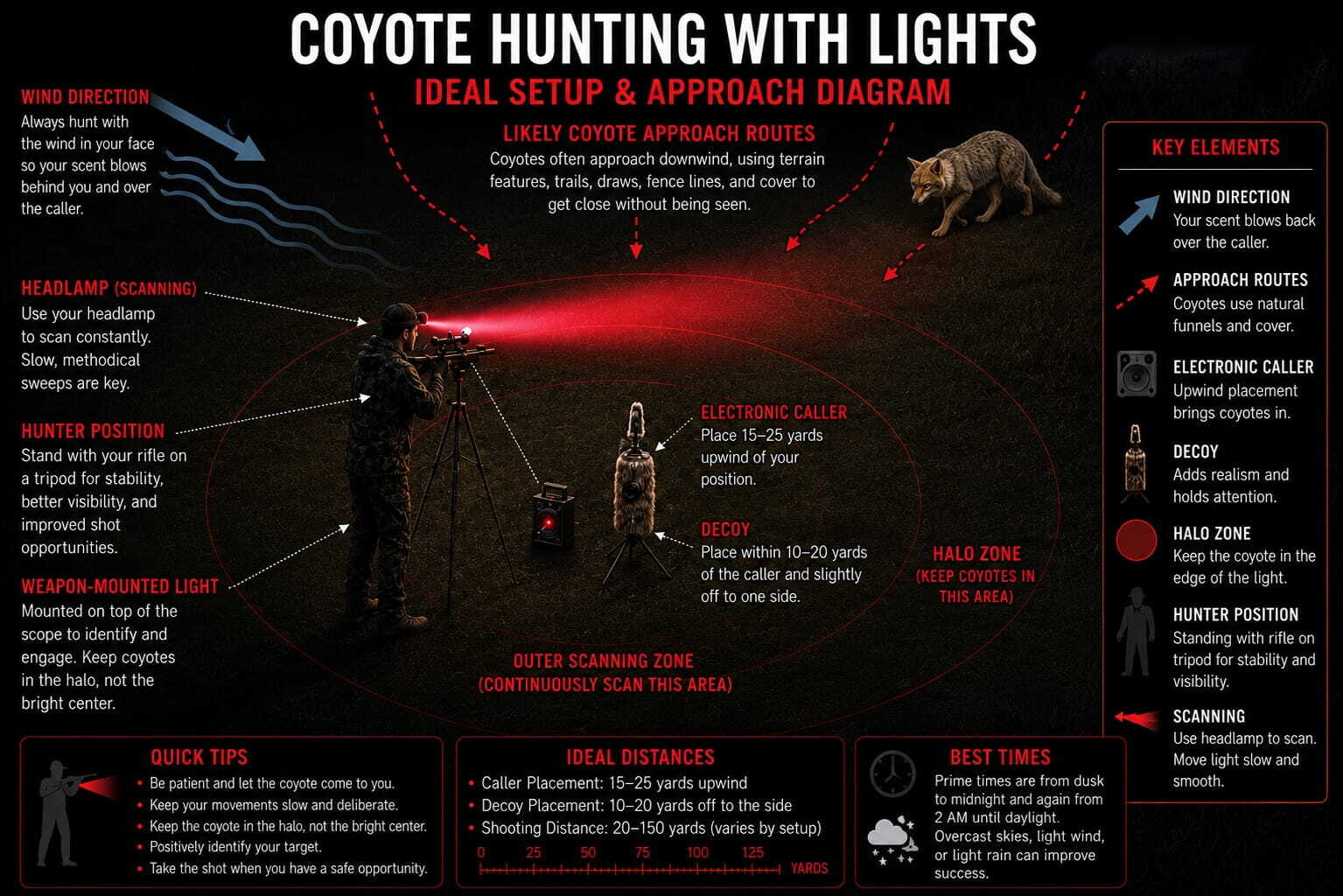
The diagram below illustrates an effective nighttime coyote hunting setup featuring hunting lights, headlamp scanning, tripod-supported shooting, electronic caller placement, wind management, halo zones, and likely coyote approach routes.
Are Hunting Headlamps Effective For Coyote Hunting?
Hunting headlamps can be extremely effective for nighttime coyote hunting because they provide hands-free illumination while allowing hunters to maintain control of their firearm, caller, and other equipment.
Headlamps are especially useful when continuously scanning for approaching coyotes and monitoring potential downwind movement.
- Continuous scanning.
- Stand entry and exit.
- Hands-free operation.
- Tracking moving coyotes.
- Monitoring downwind approach routes.
Explore: Hunting Headlamps
Standing vs Sitting When Hunting Coyotes With Lights
Both positions can be effective, but many experienced nighttime coyote hunters prefer standing because it improves visibility, scanning range, and target acquisition.
| Position | Primary Advantages |
|---|---|
| Standing | Greater visibility, improved scanning range, better target acquisition |
| Sitting | Improved concealment and comfort |
Standing often allows hunters to spot approaching coyotes sooner, especially in grasslands, rolling terrain, agricultural fields, and open country where coyotes may appear at longer distances.
Why Tripods Are So Effective For Coyote Hunting With Lights
Tripods provide stability while allowing hunters to remain standing throughout the stand. This combination often improves both detection and shooting performance.
- Improved visibility.
- Earlier coyote detection.
- Better eye reflection detection.
- Faster target acquisition.
- Greater shooting stability.
Explore:
Weapon-Mounted Lights vs Handheld Hunting Lights
Both systems can be highly effective depending on hunting style, terrain, and personal preference.
| Light Type | Primary Purpose |
|---|---|
| Handheld Light | Scanning and locating animals |
| Weapon-Mounted Light | Target identification and shooting |
Many hunters combine both systems to maximize efficiency during nighttime coyote hunts.
Why Multi-Color Hunting Lights Are Popular
Multi-color systems allow hunters to adapt to changing terrain, weather conditions, hunting pressure, and visibility requirements.
Explore: Multi-Color Hunting Lights
Red Hunting Lights For Coyotes
Red hunting lights remain one of the most popular options for nighttime coyote hunting.
- Reduced perceived brightness.
- Comfortable scanning.
- Excellent predator hunting performance.
- Strong all-around versatility.
Shop: Red Hunting Lights
Green Hunting Lights For Coyotes
Green lights often provide exceptional visibility and long-range target identification capabilities.
Shop: Green Hunting Lights
White Hunting Lights For Coyotes
White lights provide maximum visibility but generally carry the greatest risk of alerting approaching coyotes.
Shop: White Hunting Lights
Infrared Hunting Lights For Coyotes
Infrared illumination is designed for use with night vision equipment and minimizes visible light exposure.
Shop: Infrared IR Lights
Night Vision vs Hunting Lights For Coyotes
Night vision systems allow hunters to observe coyotes with reduced visible light signatures while maintaining target visibility.
Learn more: Coyote Hunting With Night Vision
Thermal vs Hunting Lights For Coyotes
Thermal optics excel at locating coyotes hidden in vegetation, terrain depressions, and other low-visibility environments.
Learn more:
Common Coyote Hunting Light Mistakes
- Ignoring wind direction.
- Failing to monitor downwind areas.
- Excessive movement.
- Poor caller placement.
- Overexposing coyotes with bright light.
- Stopping scanning too frequently.
- Failing to positively identify targets.
Recommended Gear For Coyote Hunting With Lights
Predator Hunting Lights
Shop Hunting LightsMulti-Color Lights
Shop Multi-Color LightsHunting Headlamps
Shop HeadlampsTripods
Shop TripodsPredator Calls
Shop Predator CallsElectronic Calls
Shop Electronic CallsCoyote Hunting With Lights FAQ
Red, green, white, and infrared hunting lights can all be effective depending on terrain, visibility, hunting pressure, and equipment preferences.
Yes, coyotes can detect red light, but many hunters find it less disruptive than bright white illumination when used properly.
Improper light use can alert coyotes, but proper scanning and halo techniques often allow hunters to maintain visual contact without alarming approaching animals.
The halo technique keeps approaching coyotes in the softer outer edge of the beam rather than the brightest center.
Yes. Green lights provide excellent visibility and target identification performance and are widely used by predator hunters.
Infrared light used with night vision equipment is generally far less noticeable than visible light. Many hunters use infrared illumination to reduce visible light exposure while maintaining the ability to observe approaching coyotes.
Many hunters use both. Handheld lights excel for scanning while weapon-mounted lights are commonly used for target identification and shooting.
Both methods can be effective, but standing often improves visibility, scanning range, eye reflection detection, and target acquisition, especially in open terrain where coyotes may appear at longer distances.
Hunting headlamps can be highly effective because they provide hands-free illumination while allowing hunters to maintain control of their firearm, caller, and other equipment. Many hunters use headlamps for scanning, stand entry, and monitoring downwind movement.
Multi-color systems provide flexibility and allow hunters to adapt to changing terrain, visibility conditions, hunting pressure, weather, and predator behavior.
Coyotes rely heavily on their sense of smell and frequently attempt to approach from the downwind side of a caller to verify scent before committing. This behavior is one of the primary reasons wind direction is so important in successful coyote hunting setups.