
Red Fox Hunting With Lights
Learn how to successfully hunt red foxes at night using hunting lights, including light color selection, scanning techniques, stand setup, caller placement, fox behavior around lights, and common mistakes that reduce success.
What Is The Best Light Setup For Red Fox Hunting?
The best red fox hunting light setups use a quality predator hunting light, crosswind stand positioning, continuous scanning, proper halo technique, and caller placement that draws the fox's attention away from the hunter.
- Use dedicated predator hunting lights.
- Continuously scan while calling.
- Keep foxes in the outer halo of the beam.
- Use crosswind stand setups.
- Position callers away from the shooter.
- Minimize movement when eyes appear.
Red foxes can often be called effectively at night using red, green, white, or infrared light systems depending on hunting style and equipment.
Why Hunting Lights Work For Red Fox Hunting
Hunting lights allow hunters to locate approaching foxes, identify targets, maintain visual contact, and safely take shots after dark.
Because red foxes are highly active during nighttime hours, hunting lights have become one of the most effective tools available to predator hunters.
Proper lighting systems help hunters:
- Locate approaching foxes.
- Maintain visibility during the stand.
- Identify targets safely.
- Increase nighttime success rates.
- Monitor multiple approach routes.
How Red Fox React To Hunting Lights
Red foxes can detect light. However, their reaction depends heavily on brightness, beam control, movement, distance, hunting pressure, and the color being used.
Most foxes are not reacting simply to color. They are often reacting to sudden brightness, direct exposure, excessive movement, or unnatural behavior from the hunter.
Foxes are often far more tolerant of controlled hunting lights than many hunters realize. Proper scanning and halo techniques are usually more important than the specific light color.
What Is The Best Light Color For Red Fox Hunting?
Several light colors can be effective for hunting red foxes, with each offering advantages depending on terrain, visibility, hunting pressure, and equipment preferences.
Common choices include:
- Red hunting lights.
- Green hunting lights.
- White hunting lights.
- Infrared illumination.
Many experienced hunters prefer multi-color systems because they provide flexibility across changing conditions and hunting styles.
Explore:
Red vs Green vs White vs Infrared Hunting Lights
| Light Color | Visibility | Fox Reaction Risk | Best Use |
|---|---|---|---|
| Red | High | Low-Moderate | General fox hunting |
| Green | Very High | Moderate | Longer-range identification |
| White | Excellent | Highest | Navigation and recovery |
| Infrared | Requires NV | Minimal | Night vision systems |
No single color is perfect for every situation. Local hunting pressure, terrain, visibility, and equipment all influence performance.
Night Scanning Techniques For Red Fox
Continuous scanning is one of the most important skills in fox hunting with lights.
Successful hunters typically:
- Scan constantly throughout the stand.
- Watch likely approach routes.
- Cover downwind areas.
- Move lights smoothly.
- Avoid sudden beam movements.
Foxes often appear unexpectedly and may be visible for only a short period of time before reaching cover.
The Halo Technique
The halo technique involves keeping approaching foxes within the softer outer edge of the beam rather than placing the brightest portion of the light directly on the animal.
Benefits include:
- Reduced spooking risk.
- Better target observation.
- Continuous visual contact.
- Improved shot opportunities.
Proper halo use is one of the most important skills in nighttime predator hunting.
Identifying Red Fox Eyes At Night
Fox eyes often appear as bright reflective points when illuminated by a hunting light.
Hunters should focus on:
- Eye spacing.
- Movement patterns.
- Approach behavior.
- Body shape.
- Target confirmation.
Positive target identification should always occur before taking a shot.
Stand Setup For Red Fox Hunting With Lights
Proper stand setup often contributes more to success than light color selection.
Effective setups typically:
- Use crosswinds.
- Provide visibility into approach routes.
- Allow effective scanning.
- Minimize movement.
- Create clear shooting lanes.
Learn more in: Red Fox Stand Setup & Wind Strategy
Caller Placement For Night Fox Hunting
Electronic callers should generally be positioned away from the shooter to help focus attention on the sound source rather than the hunter.
Common placement strategies include:
- 20-50 yards from the hunter.
- Crosswind positioning.
- Placement near visible terrain features.
- Placement near decoys.
Learn more in:
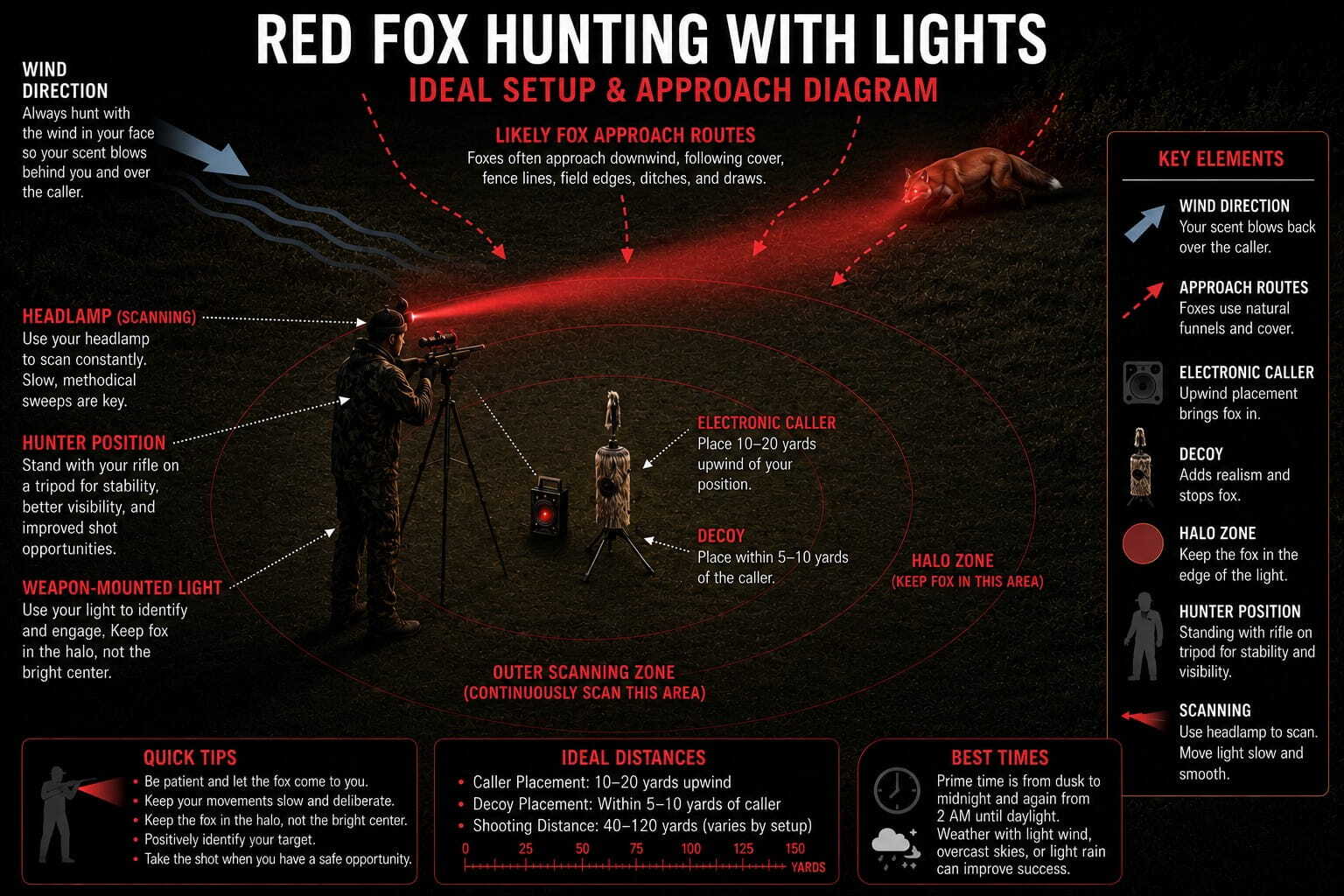
Ideal Red Fox Hunting Light Setup Diagram
The diagram below illustrates an effective nighttime red fox hunting setup using a hunting light, electronic caller, decoy, crosswind positioning, scanning zones, and likely fox approach routes.
Weapon-Mounted Lights vs Handheld Hunting Lights
Both weapon-mounted and handheld lights can be highly effective when hunting red foxes at night.
| Light Type | Primary Purpose |
|---|---|
| Handheld Light | Scanning and locating animals |
| Weapon-Mounted Light | Target identification and shooting |
Many hunters use both systems together, allowing continuous scanning while maintaining a dedicated shooting light on the firearm.
Why Multi-Color Hunting Lights Are Popular
Multi-color hunting lights provide flexibility that single-color systems cannot offer.
Advantages include:
- Adaptability to changing conditions.
- Multiple light color options.
- Improved identification flexibility.
- Greater versatility across species.
- Ability to test local predator preferences.
Explore: Multi-Color Hunting Lights
Red Hunting Lights For Red Fox
Red lights remain one of the most popular choices for fox hunters.
Benefits often include:
- Comfortable night vision preservation.
- Reduced perceived brightness.
- Excellent scanning performance.
- Strong predator hunting history.
Shop: Red Hunting Lights
Green Hunting Lights For Red Fox
Green lights are often favored for their excellent visibility and target identification characteristics.
Hunters frequently choose green lights when:
- Visibility is a priority.
- Longer-range identification is needed.
- Terrain allows extended observation distances.
Shop: Green Hunting Lights
White Hunting Lights For Red Fox
White lights provide exceptional visibility and color recognition, but they generally carry the highest risk of alerting approaching foxes.
White lights are commonly used for:
- Navigation.
- Equipment setup.
- Animal recovery.
- Target confirmation.
Shop: White Hunting Lights
Infrared Hunting Lights For Red Fox
Infrared lights are designed for use with night vision equipment and provide illumination that is generally invisible to the human eye.
Infrared systems can provide:
- Minimal visible light signature.
- Improved night vision performance.
- Excellent nighttime concealment.
Shop: Infrared IR Lights
Night Vision vs Hunting Lights For Red Fox
Both technologies can be highly effective depending on hunting style, terrain, and budget.
| Technology | Primary Advantage |
|---|---|
| Hunting Lights | Simplicity and affordability |
| Night Vision | Reduced visible light signature |
Learn more in: Red Fox Hunting With Night Vision
Thermal vs Hunting Lights For Red Fox
Thermal optics excel at detecting animals regardless of ambient light conditions and can reveal foxes long before they are visible with traditional lighting systems.
Learn more in:
Are Hunting Headlamps Effective For Red Fox Hunting?
Hunting headlamps have become increasingly popular among predator hunters because they provide hands-free illumination while allowing hunters to maintain control of their firearm, caller, and other gear.
Headlamps can be useful for:
- Continuous scanning.
- Stand entry and exit.
- Tracking approaching foxes.
- Equipment adjustments.
- Maintaining hands-free operation.
Because the beam naturally follows head movement, headlamps allow hunters to scan efficiently without carrying a separate handheld light. Many hunters find this especially beneficial during longer calling stands where constant scanning is required.
However, hunters should still avoid excessive head movement because sudden or erratic light movement can attract unwanted attention.
Explore: Hunting Headlamps
Standing vs Sitting When Hunting Red Fox With Lights
Both standing and seated hunting positions can be effective, but each offers advantages depending on terrain, vegetation height, visibility, and equipment.
| Position | Primary Advantages |
|---|---|
| Standing | Better visibility, improved eye detection, greater scanning range |
| Sitting | Improved concealment, comfort, and stability |
In many nighttime fox hunting situations, standing provides a major advantage because it increases visibility over grass, brush, crops, and uneven terrain. The elevated position can also improve eye reflection detection and allow hunters to spot approaching foxes sooner.
When hunting from a standing position, many hunters utilize dedicated hunting tripods for improved stability and target acquisition.
Explore:
Common Red Fox Hunting Light Mistakes
- Shining the brightest part of the beam directly on foxes.
- Failing to scan continuously.
- Excessive movement after eyes appear.
- Poor caller placement.
- Ignoring wind direction.
- Using excessive brightness.
- Failing to identify targets positively.
Eliminating these mistakes often improves success more than changing sounds or equipment.
Recommended Gear For Red Fox Hunting With Lights
Predator Hunting Lights
Shop Hunting LightsMulti-Color Lights
Shop Multi-Color LightsFox Calls
Shop Fox CallsElectronic Calls
Shop Electronic CallsCustom FOXPROs
Explore Custom FOXPROsSeats & Stools
Shop Seats & StoolsRed Fox Hunting With Lights FAQ
Red, green, white, and infrared systems can all be effective. The best choice depends on terrain, hunting pressure, visibility requirements, and equipment preferences.
Foxes can detect red light, but many hunters find it less disruptive than brighter white illumination when used properly.
Improper light use can spook foxes, but proper scanning and halo techniques often allow hunters to maintain visual contact without alarming approaching animals.
The halo technique keeps animals in the softer outer edge of the beam rather than exposing them to the brightest center portion of the light.
Yes. Green lights offer excellent visibility and identification performance and are used successfully by many fox hunters.
Infrared light used with night vision equipment is generally far less noticeable than visible light. While no hunting method is completely invisible to wildlife, infrared illumination is often preferred by hunters seeking to minimize visible light exposure while maintaining the ability to observe and identify approaching foxes at night.
Many hunters use both. Handheld lights excel for scanning while weapon-mounted lights are commonly used for target identification and shooting.
Both methods can be effective, but standing often improves visibility, eye reflection detection, and scanning range, particularly in taller vegetation or uneven terrain. Sitting can provide better concealment and comfort during longer stands.
Hunting headlamps can be highly effective for red fox hunting because they provide hands-free illumination while allowing hunters to maintain control of their firearm, caller, and other gear. Many hunters use headlamps for scanning, stand entry, and tracking approaching foxes. Proper beam control and minimizing excessive head movement are important to avoid drawing attention to the stand.
Multi-color systems provide flexibility and allow hunters to adapt to different conditions, terrain types, and predator responses.