
Hunting Predators With Night Lights
Learn how to hunt coyotes, foxes, bobcats, and other predators at night using red, green, white, and infrared hunting lights, including scanning techniques, identifying predators, shooting at night, and choosing the best light color for different situations.
How Do You Hunt Predators With Night Lights?
Predator hunters use colored hunting lights to scan for eye reflection, identify approaching animals, and safely take shots at night. Red, green, white, and infrared lights each offer different advantages depending on species, terrain, pressure, and visibility conditions.
- Red lights are popular for coyotes and foxes
- Green lights provide brighter visibility and contrast
- White lights offer maximum identification detail
- Infrared lights are used with night vision equipment
- Constant smooth scanning is critical for success
Modern predator hunting lights allow hunters to scan large areas, detect glowing eyes at long distances, and maintain visual control throughout the stand.
The biggest key to night hunting success is keeping the light moving smoothly and continuously. Sudden brightness changes often spook predators.
Red vs Green vs White Predator Hunting Lights
Different light colors offer different advantages depending on terrain, visibility conditions, predator species, and hunter preference.
Red Hunting Lights
Red lights are extremely popular for coyotes, foxes, and bobcats because many predators appear less sensitive to red wavelengths.
- Excellent eye reflection visibility
- Reduced predator spooking
- Popular for pressured coyotes
- Often easier on hunter night vision
Green Hunting Lights
Green lights generally provide brighter illumination and improved contrast in many terrain types.
- Brighter perceived visibility
- Good terrain detail
- Excellent for identifying animals
- Popular in open terrain
White Hunting Lights
White lights provide maximum visibility and identification capability, but can spook predators more easily.
- Maximum target identification
- Excellent terrain detail
- Can educate pressured predators
- Often used for recovery and navigation
Multi-Color Hunting Lights
Multi-color lights allow hunters to instantly switch between red, green, white, and infrared in the field.
- Adapt quickly to conditions
- Test predator reactions
- Use different colors for scanning and shooting
- Extremely versatile setups
Multi-color hunting lights allow hunters to adapt instantly to weather conditions, terrain visibility, predator pressure, and different animal reactions in real time.
How To Scan For Predators At Night
Effective scanning is one of the most important skills in predator night hunting. Usin a purpose built Night Hunting Headlamp allows you to see eye reflection better while keeping your hands free to handle your calls, remote, and weapoon. Hunters use smooth, continuous light movement to detect eye reflection before predators get close enough to identify danger.
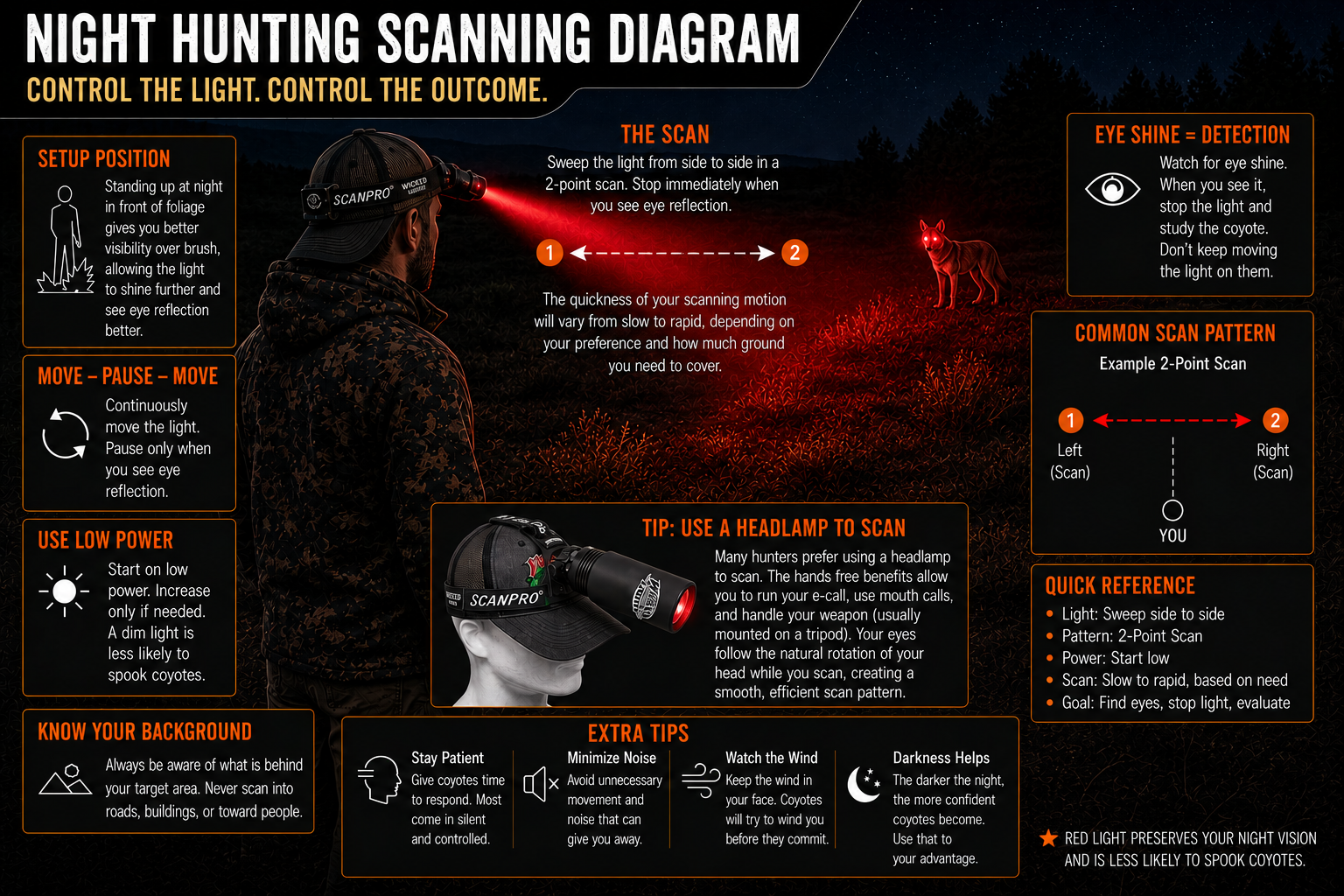
Keep The Light Moving
Smooth continuous scanning prevents sudden brightness changes that may alarm predators.
Scan At Your Pace
Moving too quickly or slowly causes hunters to miss distant eye reflection. Find the right pace for you and your terrain.
Use Halo Lighting
Many hunters use the outer edge of the beam instead of the brightest center hotspot.
Watch Downwind
Coyotes frequently attempt to circle downwind before committing to the call.
Many night hunters prefer standing positions because they improve visibility, eye reflection detection, and scanning coverage.
Identifying Predators At Night
Proper target identification is critical for safe and successful predator hunting. Hunters must learn to identify eye spacing, movement patterns, body posture, and approach behavior.
Coyotes
Coyotes usually approach cautiously, often circling downwind before committing fully.
Foxes
Foxes frequently approach aggressively and quickly, especially to rodent and bird distress sounds.
Bobcats
Bobcats commonly approach slowly and quietly, often stopping repeatedly to observe.
Livestock & Non-Targets
Always identify targets carefully before shooting, especially around livestock or populated areas.
Infrared Lights & Night Vision
Infrared (IR) lights are commonly used with digital night vision optics. IR light is invisible to the naked eye but illuminates terrain for compatible night vision equipment.
Infrared Lights
IR illuminators project invisible infrared light that enhances digital night vision visibility.
Digital Night Vision
Digital night vision devices allow hunters to see illuminated IR images at night.
Reduced Visible Light
IR systems reduce visible light exposure, which may help with pressured predators.
Thermal Is Different
Thermal optics detect heat signatures, while IR systems rely on infrared illumination.
Many modern hunting lights combine red, green, white, and infrared LEDs into one interchangeable system for maximum versatility.
Common Night Hunting Light Mistakes
- Turning lights on and off repeatedly
- Using the brightest hotspot constantly
- Scanning too quickly
- Ignoring downwind approaches
- Failing to identify animals properly
- Moving too much while scanning
Successful predator hunters focus heavily on smooth scanning, consistent light control, proper target identification, and disciplined stand setup.
Related Predator Hunting Guides
How To Call Coyotes At Night
Learn stand setup, scanning techniques, and predator night hunting strategy.
Read GuideDay vs Night Hunting
Compare predator behavior, stand setup, and tactics between day and night hunting.
Read GuideStand Setup & Wind Strategy
Learn how to position predator hunting stands and manage wind direction effectively.
Read GuideNight Hunting Lights
Explore predator hunting lights, multi-color systems, and infrared night hunting setups.
Shop LightsPredator Night Hunting Lights FAQ
Red lights are extremely popular for coyotes, although green lights also work well in many conditions.
Many predators appear less sensitive to red light, helping reduce spooking during scanning and shooting.
Green lights often appear brighter to human eyes and provide excellent terrain detail and contrast.
Infrared lights are used with digital night vision devices to illuminate terrain invisibly to the naked eye.