
Gray Fox Stand Setup & Wind Strategy
Learn how to use wind, terrain, cover, caller placement, and stand positioning to consistently create effective gray fox hunting setups during both day and night hunts.
What Is The Best Stand Setup For Gray Fox?
The best gray fox stand setups use crosswinds, focus on dense cover, provide visibility into likely travel corridors, position callers away from the hunter, and create shooting opportunities before a fox reaches thick cover.
- Use crosswinds whenever possible.
- Set up near cover and travel routes.
- Watch brush lines and timber edges.
- Place callers away from the hunter.
- Use decoys to increase commitment.
- Prepare shooting lanes before calling.
Unlike red foxes that often cross open ground, gray foxes frequently stay tight to cover and may appear suddenly at close range.
Why Stand Setup Matters More Than Calling
Gray fox hunters often focus heavily on sounds while overlooking the importance of stand positioning. In reality, poor stand setup can ruin even the best calling sequence.
Proper stand placement influences:
- How foxes approach.
- Shot opportunities.
- Visibility.
- Detection risk.
- Wind management.
- Overall success rates.
Successful hunters build stands around expected fox movement rather than simply choosing a location and hoping a fox appears.
How Gray Fox Stand Behavior Differs From Red Fox
Although many hunters group foxes together, gray foxes often behave differently than red foxes around a call.
| Behavior | Gray Fox | Red Fox |
|---|---|---|
| Use Of Cover | Very High | Moderate |
| Open Terrain Movement | Lower | Higher |
| Approach Visibility | Often Limited | Often Better |
| Timber Use | High | Moderate |
| Reaction Time For Hunters | Shorter | Longer |
Gray foxes frequently use brush, timber, creek bottoms, cedar thickets, and other dense cover to approach a stand.
Related comparison: Red Fox vs Gray Fox
Understanding Gray Fox Wind Strategy
Wind remains an important factor when hunting gray foxes, but many hunters overestimate how aggressively gray foxes use scent compared to coyotes.
Gray foxes often rely heavily on:
- Cover.
- Concealment.
- Visual confirmation.
- Terrain features.
- Short-range scent verification.
Proper wind management still improves success, but visibility into likely approach routes is often equally important.
Why Crosswind Setups Work So Well For Gray Fox
Crosswind setups consistently rank among the most productive configurations because they allow hunters to monitor likely fox travel routes while maintaining visibility into potential downwind movement.
Because gray foxes frequently approach through cover, a crosswind setup often provides the best balance between scent control and visibility.
Learn more in: Crosswind Ambush Setups .
Why Cover Is Critical For Gray Fox Hunting
Few predators rely on cover as heavily as gray foxes. Dense vegetation often provides security, travel routes, hunting opportunities, and concealment.
Productive gray fox cover often includes:
- Cedar thickets.
- Creek bottoms.
- Brushy fence rows.
- Timber edges.
- Overgrown field borders.
- Dense draws and ravines.
Many successful gray fox stands focus on openings adjacent to heavy cover rather than large open fields.
Choosing The Right Stand Location
Gray fox hunters should prioritize locations that provide visibility into likely travel routes while remaining close to cover.
High-percentage locations include:
- Creek crossings.
- Timber openings.
- Brushy field corners.
- Cedar edges.
- Fence rows.
- Transition zones between habitat types.
Related guides:
Approach Routes & Stand Entry
Gray foxes often live in close proximity to thick cover, making careful stand entry extremely important.
Successful hunters:
- Use terrain for concealment.
- Avoid skyline exposure.
- Limit noise.
- Stay out of likely travel corridors.
- Minimize scent contamination.
The objective is arriving at the stand without alerting nearby foxes.
Electronic Caller Placement
Proper caller placement helps move attention away from the hunter while encouraging gray foxes to enter visible shooting lanes.
A common setup places the caller:
- 20-50 yards from the hunter.
- Crosswind of the shooter.
- Near likely fox travel routes.
- Within clear visibility.
Learn more in:
Decoy Placement
Gray foxes often respond well to visual confirmation. Decoys can increase commitment and help hold attention away from the hunter.
Most decoys work best when positioned:
- Near the electronic caller.
- Within shooting range.
- Inside visible openings.
- Where approaching foxes can see movement.
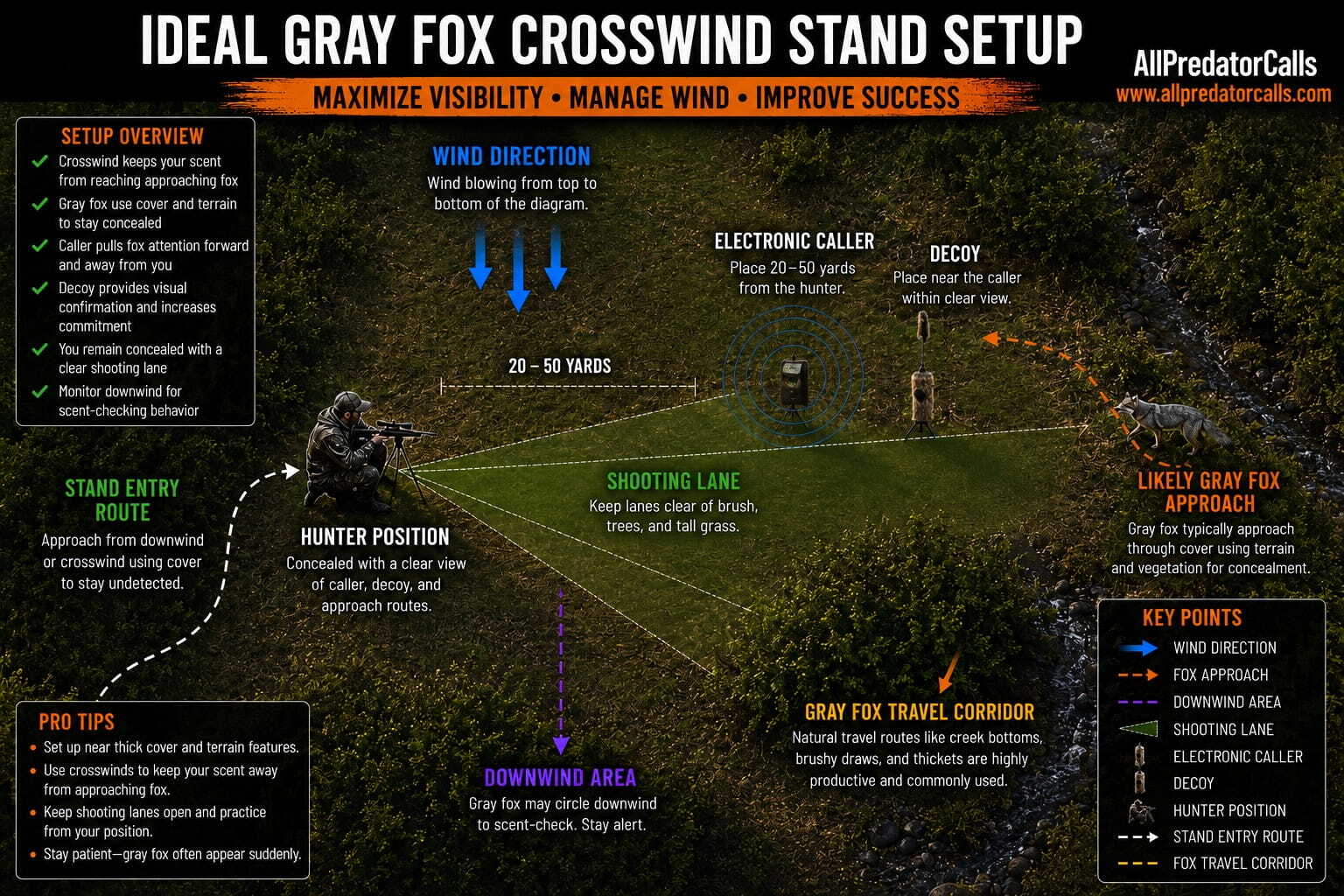
Ideal Gray Fox Crosswind Stand Setup Diagram
The diagram below illustrates an effective gray fox crosswind setup featuring dense cover, travel corridors, caller placement, wind direction, likely fox approach routes, and shooting lanes.
Daytime Gray Fox Stand Setup Strategies
Daytime gray fox hunting often occurs around brushy terrain, timber edges, creek bottoms, cedar thickets, and other dense cover where foxes feel secure.
Effective daytime setups typically focus on:
- Visibility into likely openings.
- Cover adjacent to shooting lanes.
- Crosswind positioning.
- Minimal movement.
- Concealment from approaching foxes.
Because gray foxes frequently appear suddenly at close range, hunters should prioritize readiness and visibility over long-range observation.
Comfortable Seats & Stools can help hunters remain still during longer stands.
Night Hunting Stand Setup Strategies
Gray foxes are highly active after dark, making nighttime one of the most productive periods for targeting them.
Successful night setups often emphasize:
- Visibility into cover openings.
- Efficient scanning routes.
- Clear shooting lanes.
- Stable shooting support.
- Wind awareness.
Because many gray foxes remain close to cover, hunters should pay particular attention to brush edges, timber openings, and creek corridors.
Gray Fox Stand Setups For Hunting Lights
Hunting lights remain one of the most effective tools for locating and identifying gray foxes at night.
Productive light-hunting setups often provide:
- Visibility into likely approach routes.
- Coverage of brushy edges.
- Scanning access to openings.
- Safe shot opportunities.
Learn more in:
Gray Fox Stand Setups For Night Vision
Night vision equipment performs best when hunters have visibility into travel routes while maintaining effective infrared illumination.
Effective night vision setups often focus on:
- Creek crossings.
- Timber openings.
- Brushy travel corridors.
- Transition zones.
Learn more in:
Gray Fox Stand Setups For Thermal Hunting
Thermal optics can reveal foxes hidden within cover long before they become visible through traditional optics.
However, proper stand placement remains critical because thermal detection alone does not guarantee a safe shot opportunity.
Learn more in:
Tripods vs Shooting Sticks For Gray Fox Hunting
Both systems can be highly effective depending on hunting style, terrain, and whether hunting occurs during the day or night.
| Equipment | Best Use |
|---|---|
| Shooting Sticks | Daytime seated hunting |
| Tripods | Night hunting and standing shots |
Explore:
Common Gray Fox Stand Setup Mistakes
- Setting up too far from cover.
- Ignoring likely travel corridors.
- Poor caller placement.
- Insufficient shooting lanes.
- Excessive movement.
- Overlooking wind direction.
- Alerting foxes during stand entry.
Correcting these mistakes often improves success faster than changing sounds or equipment.
Recommended Gray Fox Hunting Gear
Fox Calls
Shop Fox CallsElectronic Calls
Shop Electronic CallsPredator Decoys
Shop Predator DecoysSeats & Stools
Shop Seats & StoolsShooting Sticks & Tripods
Shop Shooting SupportsCustom FOXPROs
Explore Custom FOXPROsGray Fox Stand Setup & Wind Strategy FAQ
Crosswind setups near dense cover, travel corridors, and likely approach routes are often the most productive.
Gray fox use scent, but they often rely more heavily on cover, concealment, and visual confirmation than coyotes.
Crosswinds are generally preferred because they improve visibility into likely approach routes while reducing scent exposure.
Gray fox frequently travel through dense cover, brush, cedar thickets, and timber, allowing them to remain concealed until they are close.
Yes. Gray foxes are one of the few canid species capable of climbing trees. Their climbing ability helps them escape danger, access elevated areas, avoid predators, and navigate certain types of terrain. This unique trait is one reason gray foxes often utilize timber, brushy cover, and wooded habitats more extensively than red foxes.
Most hunters place electronic callers approximately 20 to 50 yards from the shooter depending on terrain and visibility.
Most decoys perform best when placed near the caller and within visible shooting lanes.
Yes. Alerting foxes during the approach often reduces stand effectiveness before calling even begins.