
Gray Fox Hunting 101: Complete Beginner Guide
Learn how to find, call, and hunt gray fox using proven scouting, thick-cover stand setups, gray fox distress sounds, decoys, wind, concealment, seasonal, and nighttime hunting strategies.
What is the basic formula for successful gray fox hunting? Find fresh gray fox activity near thick cover and prey, position the stand beside a visible opening, keep the downwind side in view, begin with believable prey distress, transition to gray fox distress when appropriate, use visible decoy movement, and remain ready for a fast, close-range response.
Gray fox hunting can be one of the fastest and most exciting forms of predator calling. Gray foxes frequently respond aggressively, travel through thick cover, and appear at close range with little warning.
Compared with red foxes, gray foxes are more closely associated with brush, timber, rocky slopes, creek systems, rim rock, and broken terrain. They often feel comfortable approaching through cover that would limit visibility for both the hunter and the fox.
- Gray foxes favor cover: Brush, timber, rocky terrain, creek bottoms, thickets, overgrown fields, and dense edge habitat are common.
- Responses can be fast: A gray fox may already be close to the stand when calling begins.
- Gray fox distress is important: Distress and fight sounds can trigger territorial, aggressive, social, or curiosity-driven responses.
- Movement control is critical: Close-range animals can detect small movements around the firearm, remote, light, or mouth call.
- Decoys can be highly effective: Visible movement gives the fox something to locate and can focus attention away from the hunter.
- Gray foxes can climb trees: Unlike most North American canids, gray foxes can climb leaning trunks and low branches to escape danger, rest, or pursue food.
Set up where you can see a small opening beside thick cover. Gray foxes often avoid crossing large exposed areas but will quickly enter a controlled opening close to secure vegetation.
Gray fox seasons, licenses, legal methods, artificial lights, electronic calls, night vision, thermal optics, harvest reporting, public-land access, and trapping regulations vary by jurisdiction. Verify all current requirements before hunting.
- Confirm the fox season: Gray fox regulations may differ from rules for other predator species.
- Check nighttime regulations separately: Legal hours, lights, weapons, optics, and public-land restrictions can change after dark.
- Identify the target: Never shoot at movement, eyeshine, a heat signature, or an obscured animal without positive identification.
- Confirm the background: Dense habitat can conceal roads, homes, livestock, hunters, hikers, vehicles, and terrain hazards.
- Plan for close approaches: Gray foxes may suddenly appear near the caller, decoy, or hunter.
- Establish partner shooting zones: Determine safe directions before calling begins.
- Handle harvested foxes carefully: Gloves help limit contact with blood, fleas, parasites, and bodily fluids.
Do not assume that general predator regulations apply automatically to gray foxes. Confirm current species, season, license, equipment, land-access, and harvest requirements before every hunt.
Gray foxes thrive in landscapes that combine prey, dense concealment, rocky or wooded travel routes, and small openings where they can hunt. They are especially well adapted to moving through tangled vegetation and broken terrain.
- Brush and thickets: Dense vegetation provides security, bedding cover, prey, and concealed approaches.
- Timber and woodland edges: Gray foxes use forest trails, logging roads, clearings, fallen timber, and edge transitions.
- Rocky slopes and rim rock: Ledges, boulders, cliffs, benches, and rock piles create travel routes, shelter, and observation locations.
- Creek bottoms and drainages: Waterways commonly provide vegetation, prey, tracks, and natural movement corridors.
- Overgrown fields: Tall grass, brush, fence rows, and abandoned farmland can hold rodents, rabbits, birds, and foxes.
- Small openings near cover: Gray foxes often enter compact openings more confidently than large exposed fields.
- Trees and elevated cover: Gray foxes may climb leaning trees, low branches, logs, banks, and rocky features.
Gray fox responses can be motivated by feeding, curiosity, territorial behavior, social interaction, breeding activity, or concern over another fox in distress. Understanding the likely motivation helps determine when to use prey distress, gray fox distress, pup distress, or vocalizations.
Position the stand where thick cover meets a logging road, creek crossing, rocky opening, brush line, or small clearing. This gives the fox security while creating a visible approach lane.
Scouting helps confirm that gray foxes are currently using an area and identifies the cover edges, travel corridors, feeding areas, and openings that should be incorporated into the stand.
- Look for tracks: Mud, sand, snow, dusty roads, creek crossings, logging roads, and trail edges commonly preserve fox tracks.
- Find scat and marking sites: Gray foxes may leave scat on trails, rocks, logs, roads, intersections, and other visible locations.
- Identify prey concentrations: Rabbits, rodents, birds, fruit, mast, insects, and other food sources can influence fox movement.
- Study travel corridors: Creek bottoms, rocky benches, logging roads, saddles, fence lines, brush edges, and timber trails can funnel movement.
- Watch for denning cover: Rock piles, hollow logs, banks, brush piles, tree roots, culverts, and cavities may show repeated activity.
- Use trail cameras where legal: Cameras can verify current activity, travel direction, group size, and time of movement.
- Evaluate several stand openings: Mark small clearings that provide visibility without forcing a fox to leave secure cover for too long.
Gray foxes often move through brush beside roads and trails rather than directly down the center. Search soft ground, crossings, gaps, and edge cover for secondary sign.
Gray fox hunting gear should support quiet movement, realistic calling, fast target acquisition, close-range visibility, concealment, and stable shooting in brushy or rocky terrain.
- Fox calls : Mouth calls can produce rabbit, rodent, bird, gray fox distress, fox-fight, pup distress, and coaxing sounds.
- Electronic predator calls : Place the sound away from the hunter and provide remote access to prey distress, fox distress, and vocalizations.
- Custom FOXPRO calls : Custom programming can organize gray fox sounds, prey distress, pup distress, and complete calling sequences.
- Predator decoys : Visible motion near the sound can focus a responding fox away from the hunter.
- Sticks & tripods : Improve stability and keep the hunter prepared for a fox that appears suddenly.
- Seats & stools : Improve comfort, body position, visibility, and movement control during seated stands.
- Camouflage and concealment : Break up the hunter’s outline at the edge of timber, brush, rocks, or small openings.
- Camouflage gloves : Reduce visible hand movement during close approaches.
- Head nets and face covers : Conceal exposed skin and facial movement.
- Wind checkers : Reveal subtle shifts, thermals, and wind movement around timber, rocks, ridges, and creek systems.
- Night hunting lights : Support scanning and positive identification after dark where legal.
Lightweight and maneuverable equipment works especially well in gray fox habitat because stands may involve short hikes, close cover, uneven ground, and fast responses.
Build a Beginner Predator Hunting Setup → Explore the Best Gear for Fox Hunting → Build Your First Predator Hunting Kit → Learn How Much Predator Hunting Gear You Need →Electronic callers and mouth calls can both call gray foxes. Electronic callers provide remote sound placement and rapid access to multiple recordings, while mouth calls provide portability, natural variation, and immediate control.
Electronic Call Advantages
- Place the sound and decoy away from the hunter.
- Reduce movement while calling.
- Provide prey distress, gray fox distress, and fight sounds.
- Allow fast sound and volume changes.
- Support continuous calling in dense cover.
- Keep both hands available for nighttime scanning.
Mouth Call Advantages
- Lightweight and easy to carry through rough cover.
- Require no batteries or remote.
- Allow immediate changes in pitch and emotion.
- Produce sharp, aggressive distress sounds.
- Work well for subtle close-range coaxing.
- Provide backup if electronic equipment fails.
A practical beginner setup may include an electronic caller loaded with prey and gray fox sounds plus one dependable mouth call for variation, backup, or finishing a fox that stops short.
Compare Electronic Calls and Mouth Calls → Compare Open-Reed and Closed-Reed Calls → Learn Electronic Calling Fundamentals → Learn Mouth Calling Fundamentals → Call Foxes with Electronic Calls → Call Foxes with Mouth Calls → Compare Electronic Calls for Foxes → Compare Electronic Calls for Heavy Cover → Compare Mouth Calls for Foxes → Compare Mouth Calls for Heavy Cover →Gray foxes can respond strongly to prey distress, gray fox distress, fox-fight sounds, pup distress, and other emotionally intense sounds. The sequence should still remain believable and match the habitat, distance, weather, season, and hunting pressure.
Useful Gray Fox Sound Categories
- Cottontail distress: A dependable opening sound in many gray fox habitats.
- Rabbit distress: Provides greater volume and can reach across timber, canyons, brush, or windy terrain.
- Bird and woodpecker distress: High-pitched alternatives that work well around timber and dense cover.
- Rodent, vole, and mouse sounds: Realistic prey sounds for subtle or close-range calling.
- Gray fox distress: Can trigger territorial, aggressive, social, or curiosity-driven responses.
- Fox fighting sounds: May suggest a territorial conflict or feeding dispute.
- Pup distress: Can create social, protective, or aggressive interest and may help move a fox that hesitates.
Volume
Dense vegetation can absorb sound, and wind or broken terrain may require additional projection. However, a gray fox may already be close to the stand, so begin at a controlled level and increase volume when conditions justify it.
A Beginner Gray Fox Sequence
- Begin with cottontail, rabbit, bird, or rodent distress.
- Allow the prey sound enough time to reach nearby cover.
- Watch closely for a fast, silent approach.
- Transition to gray fox distress if the prey sound does not produce a visible response.
- Use fox-fight or pup distress when a fox barks, stops, hangs up, or appears territorial.
- Lower the volume or mute the caller when a committed fox visually locks onto the decoy.
Gray foxes can respond well to sound changes, but that does not mean changing sounds every few seconds. Give each sound time to work and make each transition for a clear behavioral reason.
A strong gray fox stand overlooks a small opening, trail, creek crossing, logging road, rocky bench, or brush edge while maintaining concealment and visibility of the downwind side.
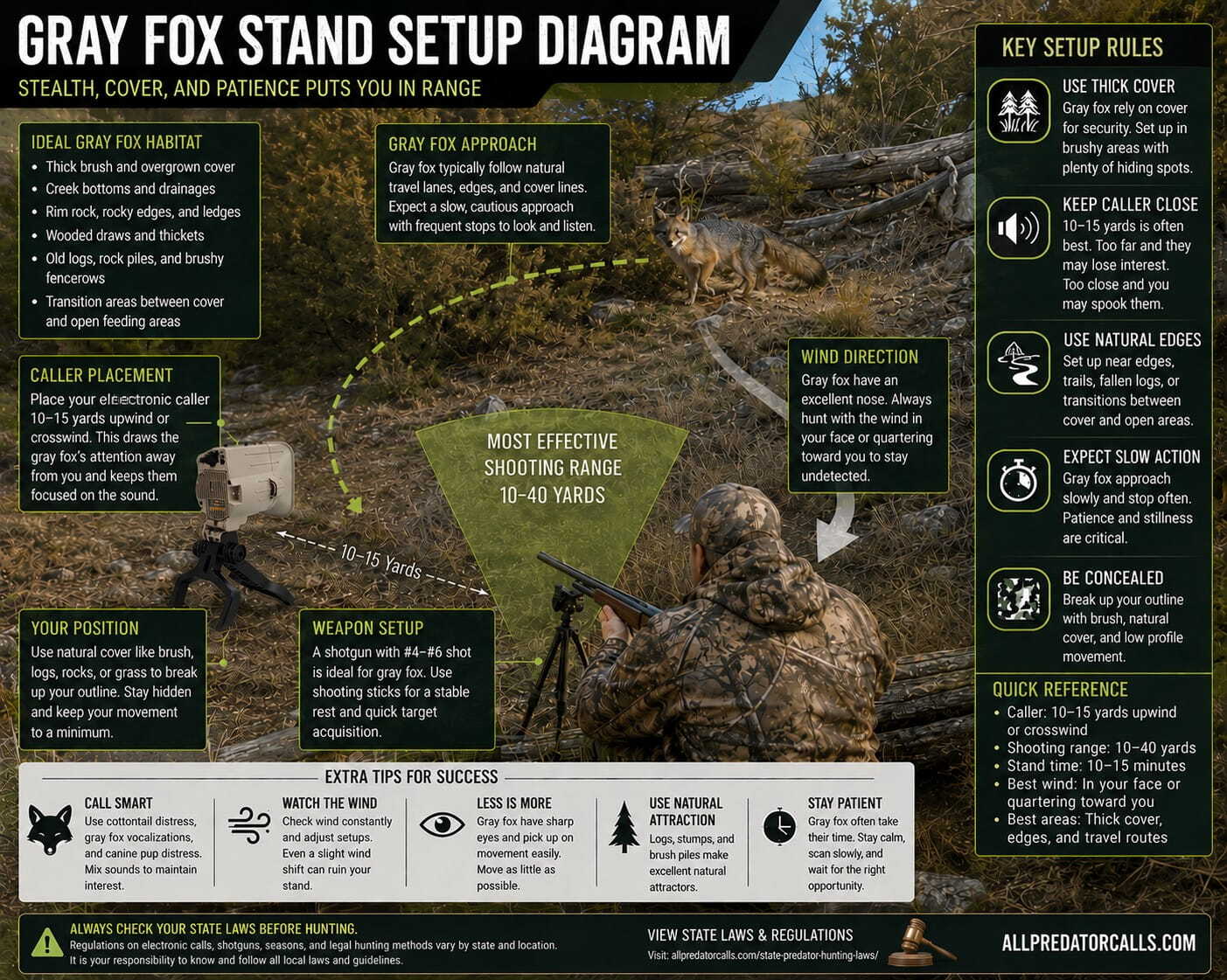
- Use tight openings: Small clearings often feel safer to a gray fox than a large exposed field.
- Watch cover edges: A fox may travel just inside vegetation before suddenly entering the opening.
- Use a crosswind when practical: Maintain visibility of a fox attempting to scent-check the sound.
- Avoid blind close cover behind the hunter: A fox can approach silently from the rear or side.
- Use slight elevation: A bank, rock, stool, or small rise can improve visibility into brush and terrain depressions.
- Place the caller away from the hunter: Approximately 20–40 yards can work well in many daylight setups, but visibility and safe shooting lanes should determine the distance.
- Make the decoy visible: Position movement where a fox approaching through cover can see it before reaching the hunter.
- Use subtle decoy movement: Erratic prey-like motion is generally more believable than excessive spinning or noise.
- Prepare before calling: Position the caller, decoy, support, firearm, remote, and mouth calls before the sequence begins.
Gray foxes may circle, stop at the cover edge, or approach from behind the hunter. Continue watching every opening and likely travel route around the stand.
Gray fox responses are frequently fast because foxes may already be close to the stand in dense habitat. However, response time varies with terrain, population density, weather, sound travel, and hunting pressure.
- Ten to twenty minutes is common: Many nearby foxes respond during the early portion of the stand.
- Twenty to thirty minutes may be appropriate: Broken terrain, wind, low fox density, or pressured animals can require more time.
- Thick cover hides responses: A fox may be close without becoming visible.
- Barking does not always mean the stand is over: Gray fox distress or pup distress may still trigger an approach.
- Fresh sign justifies patience: High-confidence locations may deserve additional time.
Finish with a quiet observation period. Scan the caller, decoy, downwind side, brush edges, rocks, trees, logging roads, and rear approach before standing.
A gray fox may be watching from only a few yards inside the cover. Stop calling and observe quietly before dismantling the stand.
A gray fox may charge directly toward the sound, weave through brush, circle downwind, bark from cover, stop at the opening, or lock onto the decoy and continue forward.
- Remain still: A close fox can detect small movements around the remote, firearm, light, or call.
- Stay ready from the beginning: Gray foxes can appear within the first few minutes.
- Watch the entire cover edge: Do not assume the fox will enter at the caller.
- Read body language: A committed fox behaves differently from one that is barking, retreating, or attempting to circle.
- Use gray fox distress when appropriate: Distress or fight sounds may trigger an aggressive or territorial response.
- Use pup distress for a hesitant fox: Pup distress can create additional emotional or social interest.
- Mute or lower the caller after visual commitment: A fox focused on the decoy may continue without additional volume.
- Continue watching after the first fox: A second fox may be following through cover.
Avoid immediately increasing volume or moving. Try gray fox distress, fox-fight sounds, pup distress, a quiet coaxer, or a short silent period while watching the downwind side.
Gray fox movement and calling responses can change with food availability, vegetation, weather, breeding activity, denning, dispersal, and hunting pressure.
Fall
Young foxes may disperse and explore unfamiliar areas. Rabbit, bird, and rodent distress are dependable starting sounds, while thick vegetation may require tighter stand placement.
Winter and Breeding Season
Cold weather can increase food needs, while breeding activity can increase travel and social interest. Prey distress, gray fox distress, fox-fight sounds, pup distress, and fox vocalizations may all be useful.
Spring and Denning Periods
Activity may concentrate around denning habitat, secure cover, and reliable food. Hunters should follow local season structures and wildlife-management regulations.
Summer
Heat and dense vegetation can shift movement toward early morning, evening, and nighttime. Creek systems, shaded timber, rocky cover, and water may become more important.
Learn How Predator Hunting Changes by Season → Understand Fox Breeding Season → Understand Fox Denning Behavior → Learn How Weather Affects Predator Hunting → Match Calling Sounds to Weather → Match Calling Sounds to Hunting Pressure →Night hunting can be highly productive for gray foxes where legal. Their close-range, fast-moving responses make continuous scanning, stable support, caller placement, and target identification especially important.
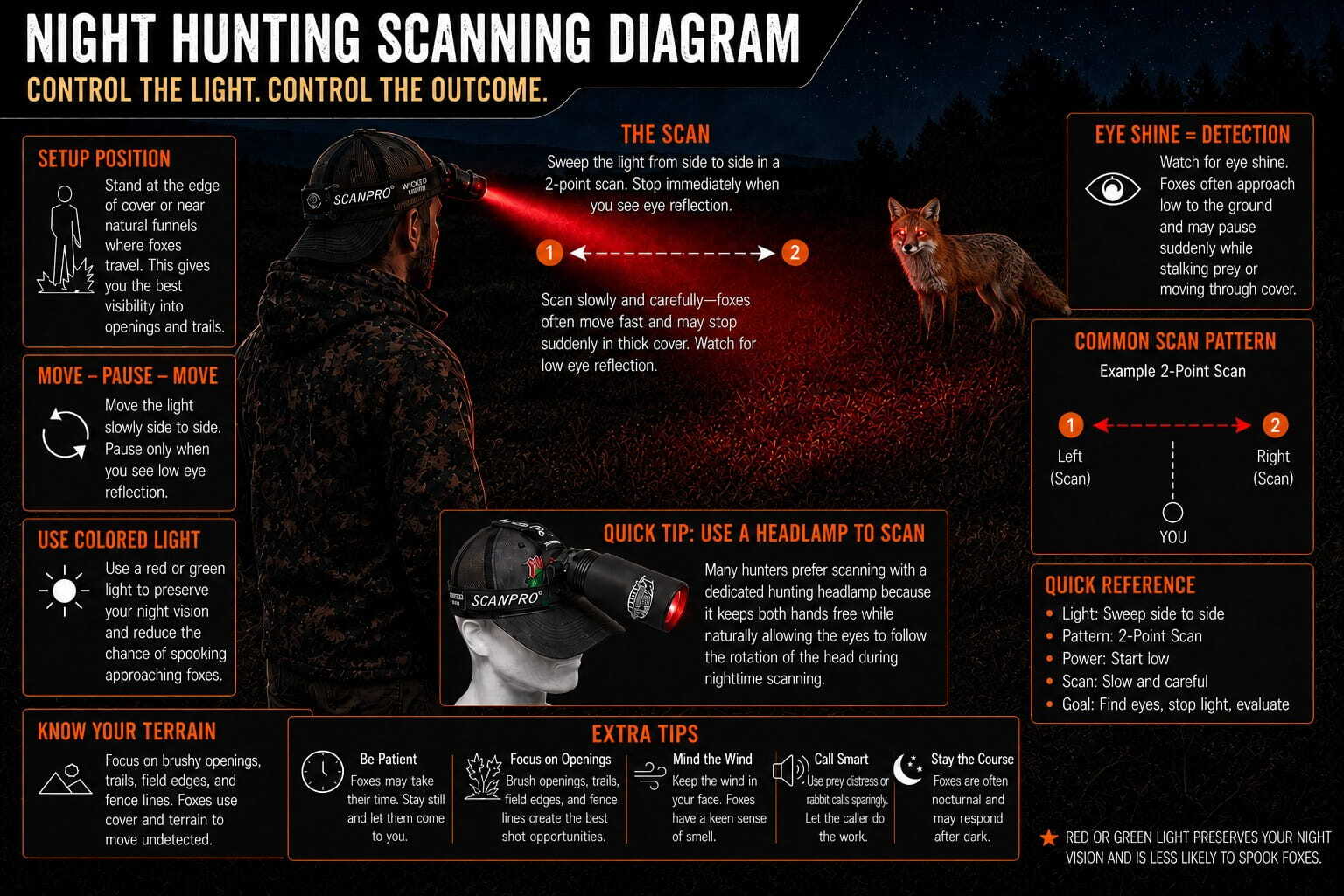
- Scout during daylight: Identify roads, homes, livestock, fences, rocks, brush, drop-offs, trails, and safe shooting lanes.
- Scan continuously: A gray fox can appear and cross the opening quickly.
- Use a hands-free scanning headlamp: The beam follows natural head movement while both hands remain available.
- Use a separate weapon-mounted light: A headlamp beam points toward the ground when the hunter lowers their head into a riflescope.
- Red light is a strong starting choice: It preserves the hunter’s night vision and is widely used for fox scanning.
- Use multi-color capability when available: Red, green, white, and infrared support different scanning, identification, recovery, and night-vision needs.
- Stand when terrain permits: Standing can improve visibility over brush, grass, rocks, and uneven terrain.
- Use a tripod: Keep the firearm supported while scanning and operating the caller.
- Keep the caller relatively close: Approximately 5–15 yards can work well at night when terrain, wind, cover, and safe shooting lanes permit.
- Watch close cover: Gray foxes may appear immediately beside the opening or hunter.
- Confirm the target: Never shoot based only on eyeshine, movement, sound, or a thermal heat signature.
Keep the firearm safely supported and establish partner shooting zones before calling. Do not swing a firearm toward unidentified eyeshine or movement around the stand.
- Hunting without current sign: Good-looking cover does not guarantee active foxes.
- Setting up too far from cover: Gray foxes may hesitate to cross a large exposed area.
- Creating a blind rear approach: Close cover behind the hunter can hide an approaching fox.
- Failing to prepare before calling: A fox may respond before the hunter finishes arranging equipment.
- Watching only the caller: Foxes may circle, bark, or stop along another cover edge.
- Moving during the approach: Close-range foxes can detect minor hand and head movement.
- Starting at excessive volume: A fox may already be nearby in dense habitat.
- Changing sounds constantly: Sound progression is useful only when each transition has a purpose.
- Ignoring gray fox distress: Hunters who use only prey distress may overlook an effective territorial or aggressive trigger.
- Hiding the decoy: Motion cannot attract a fox when brush or terrain blocks it from view.
- Leaving immediately after silence: A fox may be standing just inside the cover.
- Overhunting one location: Repeated vehicles, lights, calling sounds, and stand locations can change fox behavior.
- Scanning too slowly at night: A fast-moving fox can cross an opening between scanning passes.
Record the wind, caller and decoy placement, opening size, sound sequence, stand duration, barking, eyeshine, and route of approach. These details reveal patterns that can improve later stands.
Consistent gray fox hunting success comes from combining active habitat, tight stand placement, realistic sounds, visible decoy movement, favorable wind, and readiness for a fast response.
- Scout for fresh gray fox activity before calling.
- Focus on thick cover, timber, creeks, rocks, and edge habitat.
- Use small openings rather than large exposed fields.
- Prepare all equipment before calling begins.
- Start with believable prey distress.
- Use gray fox distress, fight sounds, and pup distress strategically.
- Keep the downwind side and rear approach visible.
- Place the caller and decoy away from the hunter.
- Remain ready for an immediate close-range response.
- Use hands-free scanning and stable support at night.
- Finish every stand with a quiet observation period.
Gray Fox Hunting 101 FAQ
These frequently asked questions cover gray fox habitat, tree-climbing behavior, scouting, calling sounds, electronic and mouth calls, decoys, caller placement, stand duration, wind, and nighttime hunting.
A beginner needs a dependable electronic or mouth call, camouflage, stable shooting support, a comfortable seat, a wind checker, and access to active gray fox habitat. A visible motion decoy is also useful. Night hunters need a scanning headlamp, a separate weapon-mounted light or legal night optic, and a tripod.
Cottontail distress, rabbit distress, bird distress, woodpecker distress, rodent sounds, gray fox distress, fox-fight sounds, and pup distress are effective choices. The best sound depends on habitat, season, wind, distance, and hunting pressure.
Productive locations include brushy draws, timber edges, creek bottoms, rocky slopes, rim rock, logging roads, overgrown fields, thickets, and small openings beside secure cover. Fresh tracks, scat, prey, or camera activity make a location more promising.
Yes. Gray foxes can climb leaning trunks, low branches, logs, and other angled surfaces. They may climb to escape danger, rest, search for food, or move through suitable cover.
Both can be effective. Electronic calls place sound away from the hunter and provide remote access to prey and fox sounds. Mouth calls are lightweight, battery-free, and useful for aggressive sound variation or subtle close-range coaxing. Many hunters carry both.
Many gray fox stands last approximately 10–20 minutes because foxes may already be close in thick habitat. Twenty to thirty minutes may be appropriate in broken terrain, wind, low-density areas, or locations with pressured foxes.
Approximately 20–40 yards can work well in many daylight gray fox stands, but cover, visibility, wind, decoy placement, and safe shooting lanes should determine the actual distance. At night, approximately 5–15 yards can often work well when conditions permit.
Yes. A visible motion decoy helps a gray fox locate the sound, gives it something to approach, and focuses its attention away from the hunter. The decoy should be visible from likely cover routes without creating an unsafe shooting angle.
Early morning, late evening, and nighttime can be highly productive because gray foxes frequently move during lower-light periods. Cooler weather and breeding-season activity may also increase movement, but fresh sign and favorable wind remain important.
Night hunting can be highly effective where legal because gray foxes are commonly active after dark. Continuous headlamp scanning, positive target identification, favorable wind, a tripod-supported firearm, and separate scanning and shooting systems are important for safe and effective night stands.