Coyote Hunting 101: Complete Beginner to Advanced Guide
Learn how to scout, set up, call, and successfully hunt coyotes with proven field-tested strategies.
Coyote hunting can be exciting, challenging, and highly rewarding, but safety and legal responsibility should always come first. Understanding local regulations and maintaining safe hunting practices are essential parts of ethical predator hunting.
Laws involving predator hunting can vary significantly depending on state regulations, hunting seasons, weapon restrictions, nighttime hunting rules, public land access, and licensing requirements.
- Know your local hunting laws: Always verify current regulations for seasons, legal hunting methods, nighttime restrictions, licensing requirements, and public land access before hunting.
- Practice safe firearm handling: Always positively identify your target, maintain awareness of your surroundings, and follow safe firearm practices at all times.
- Understand property boundaries: Respect private property, obtain permission when required, and remain aware of nearby roads, livestock, homes, and recreational areas.
- Use caution during night hunting: Reduced visibility requires additional attention to target identification, safe shooting lanes, and communication with hunting partners.
- Protect yourself when handling animals: Many hunters wear gloves while handling coyotes or other predators to reduce exposure to parasites, fleas, and potential disease transmission.
- Respect wildlife and landowners: Ethical hunting practices help preserve predator hunting opportunities and maintain positive relationships with landowners and local communities.
Responsible hunters not only improve safety in the field, but also help protect the future of predator hunting for other hunters.
Find Your States Hunting Laws →
Preparing properly before heading into the field can make predator hunting safer, more comfortable, and far more productive. Even short hunts can quickly become difficult without the right preparation and equipment.
- Bring water and food: Long stands, changing weather conditions, and remote locations can quickly drain energy and hydration levels.
- Start with a full tank of gas: Predator hunters often cover large areas between stands, especially in rural or remote country.
- Carry a basic first aid kit: Minor injuries, cuts, or unexpected emergencies are easier to handle when basic medical supplies are available.
- Pack navigation tools: GPS devices, mapping apps, or physical maps help hunters safely navigate unfamiliar terrain and avoid getting lost.
- Bring extra batteries and charging equipment: Electronic callers, lights, optics, and thermal devices all depend on reliable power in the field.
- Dress for changing conditions: Layered clothing helps hunters stay comfortable during early mornings, wind, cold temperatures, and changing weather.
- Tell someone your plans: Always let someone know where you will be hunting, especially during night hunts or in remote areas with limited cell coverage.
Good preparation helps hunters spend more time focused on locating and calling coyotes instead of dealing with avoidable problems in the field.
While successful coyote hunting does not require expensive equipment, the right gear can improve efficiency, comfort, concealment, and overall success in the field.
Many experienced hunters focus on carrying lightweight, reliable gear that allows them to move quietly, stay comfortable during long stands, and adapt to changing terrain and weather conditions.
- Camouflage and Concealment : Proper camouflage helps break up your outline and reduce movement detection, especially in open country or heavily pressured areas.
- Electronic Predator Calls : Electronic callers allow hunters to project realistic sounds away from their position while controlling volume, sound selection, and calling sequences more effectively.
- Mouth Calls : Compact and lightweight mouth calls remain extremely effective and serve as valuable backup options if electronic equipment fails.
- Decoys : Motion decoys help focus a coyote’s attention away from the hunter and can improve commitment during the final approach.
- Shooting Sticks and Bipods : Stable shooting support improves accuracy and helps maintain readiness during longer stands.
- Seats and Stools : A good seat, chair, butt pad, or stool goes a long way in making your time on stand more comefortable. Sitting for 10-30 minutes can be hard on your rear. A good seat or stool will also improve your body position and line of sight over your stand terrain.
- Binos and Rangefinders: Binoculars will help you scan terrain faster and see approcahing animals easier (especially in wide open terrain). Ranegfinders help you know distances for more accurate shot placement.
- Night Hunting Equipment : Lights, thermal optics, and infrared equipment can greatly improve visibility and target identification during nighttime hunts where legal.
- Wind Indicators and Scent Control: Understanding wind direction is often more important than scent elimination, but many hunters still use scent-management tools to reduce contamination while entering stands.
The best gear setup is often the one that matches local terrain, hunting style, visibility conditions, and personal comfort while remaining reliable in the field.
Shop Predator Hunting Gear →
Successful coyote hunting starts long before you ever sit down on a stand. Consistently finding active coyotes is one of the biggest factors separating successful hunters from unsuccessful ones.
Coyotes are highly adaptable predators that constantly move in search of food, water, cover, and security. Learning how to identify active areas can dramatically improve your calling success.
- Look for tracks and scat: Fresh sign on roads, trails, field edges, and creek bottoms can quickly reveal active travel routes.
- Focus on food sources: Areas holding rabbits, rodents, livestock, or other prey species often attract coyotes consistently.
- Locate bedding and travel cover: Coyotes prefer areas with brush, washes, tall grass, draws, and terrain breaks that provide security while traveling.
- Use mapping tools and aerial imagery: Satellite maps can help identify water sources, funnels, access roads, and likely stand locations before ever entering the field.
- Locate coyotes with sound: Group howls, lone howls, sirens, or locator calls at dawn and dusk can help pinpoint active coyotes in the area.
The best hunters spend nearly as much time scouting as they do calling. Even excellent calling techniques struggle to produce results if coyotes are not actively using the area.
Learn More Predator Hunting Strategies →
A good stand setup can dramatically increase your chances of calling a coyote into range. Even the best calls and sounds may fail if your setup allows coyotes to see, smell, or detect movement before committing.
Coyotes rely heavily on their nose and eyesight when approaching a call. Understanding wind direction, visibility, concealment, and approach routes is critical for consistent success.
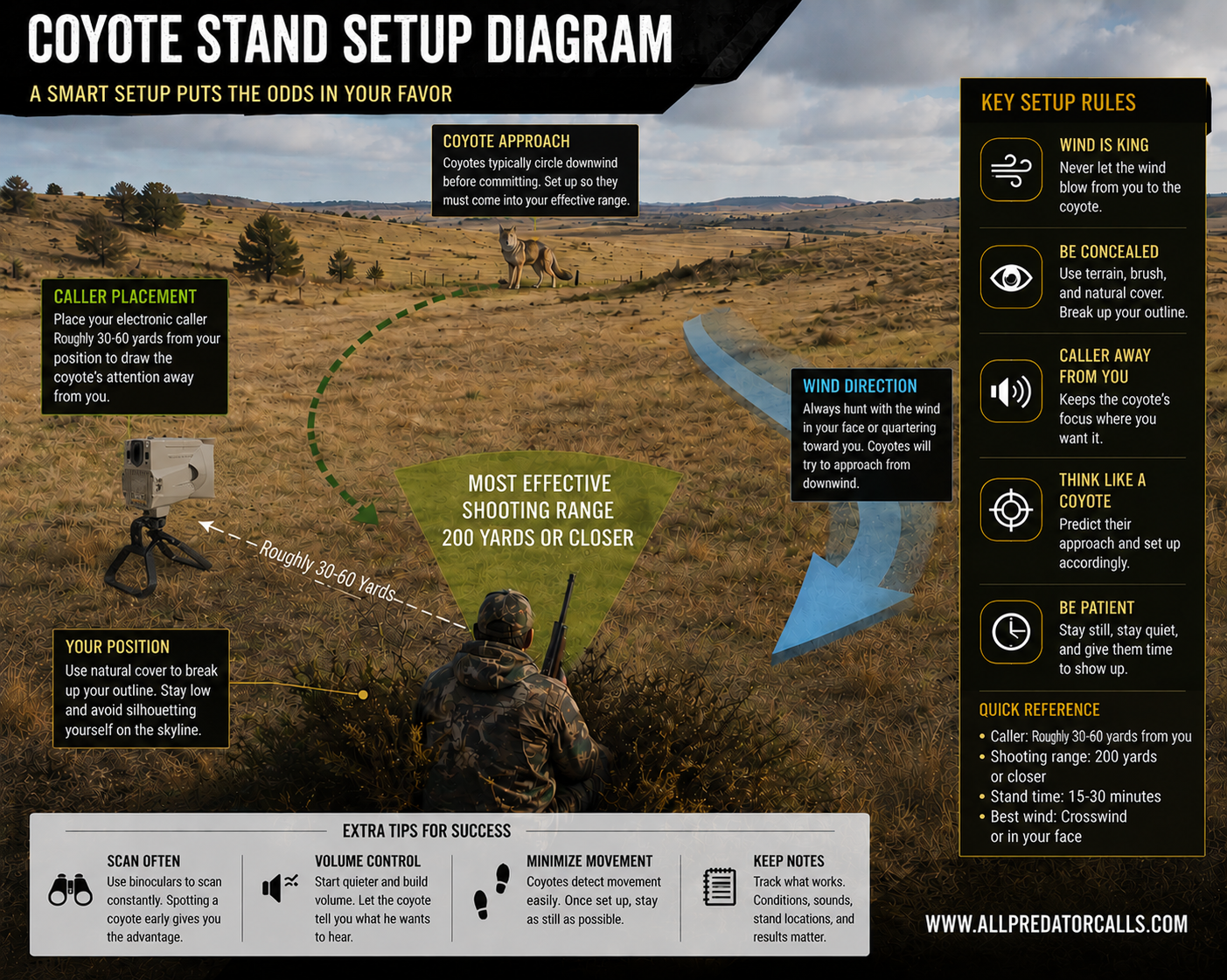
- Always pay attention to wind direction: Coyotes commonly attempt to circle downwind before fully committing. Set up with a crosswind whenever possible and maintain visibility of your downwind side.
- Use natural concealment: Brush, shadows, terrain breaks, rocks, and vegetation help break up your outline and reduce movement detection.
- Avoid skyline exposure: Walking over ridges or setting up against open horizons can silhouette hunters and alert nearby coyotes.
- Keep the sun at your back when possible: This can make it more difficult for approaching coyotes to detect movement and gives hunters better visibility.
- Plan your entry carefully: Quiet approaches that avoid excessive noise, scent contamination, and visible movement often lead to better stand success.
- Watch likely travel routes: Fence lines, creek bottoms, washes, field edges, and terrain funnels often guide approaching coyotes into shooting range.
Pro Tip
Many experienced coyote hunters choose stand locations that force approaching coyotes to expose themselves before reaching the hunter’s downwind side. Terrain funnels, fence crossings, creek bottoms, and open shooting lanes can all help create higher-percentage setups.
Common Stand Setup Mistakes
- Setting up without checking the wind direction before calling.
- Walking across open terrain where approaching coyotes can easily spot movement.
- Sitting where visibility is too limited to detect coyotes circling downwind.
- Allowing the electronic caller to sit too close to the hunter.
- Making unnecessary movement after calling sequences begin.
- Skyline exposure on ridges, hills, or open terrain.
Many experienced hunters believe stand setup is more important than the actual sounds being played. A properly positioned hunter with favorable wind and concealment can consistently outperform poor setups, even with simple calling sequences.
Explore More Predator Hunting Tactics →
Electronic calls have become one of the most effective tools in modern coyote hunting. They allow hunters to project sound away from their position, control volume precisely, and play a wide variety of realistic prey and vocal sounds.
While there is no single “magic” sound for coyotes, understanding when and how to use different sounds can dramatically improve your success rate.
- Prey distress sounds: Rabbit, rodent, bird, and other prey distress sounds consistently produce coyotes year-round and are often the best starting point for beginners.
- Pup distress sounds: Pup distress can trigger aggressive or territorial responses, especially after a shot or during denning season.
- Coyote vocals: Howls, interrogation howls, challenge howls, and female invitation calls are especially effective during breeding season and territorial periods.
- Volume control matters: Many hunters start at lower volume before gradually increasing intensity, while others use aggressive volume immediately in windy or open terrain.
- Stand length: Most stands last between 15–30 minutes depending on terrain, pressure, visibility, and coyote density.
- Sound variation: Changing sounds during a stand can sometimes trigger responses from coyotes that initially ignored the first sequence.
Quick Tip: If coyotes hang up out of range or refuse to fully commit, lowering the volume or switching to subtle rodent sounds can sometimes trigger cautious coyotes into closing the final distance.
Electronic callers are especially effective when paired with proper stand setup, favorable wind direction, and realistic movement from decoys or natural terrain features.
Many experienced hunters place their electronic caller 30–60 yards away from their shooting position to help draw a coyote’s attention away from the hunter.
Shop Electronic Predator Calls →
Mouth calls remain one of the most effective and versatile tools in predator hunting. Even with the popularity of electronic callers, many experienced hunters still rely heavily on hand calls for flexibility, realism, and simplicity in the field.
Mouth calls are lightweight, dependable, and allow hunters to create a wide range of prey distress sounds, coyote vocals, and subtle sound variations that can sometimes trigger responses from pressured coyotes.
- Closed reed calls: Closed reed calls are generally easier for beginners to learn and produce consistent sounds with less practice.
- Open reed calls: Open reed calls offer greater sound flexibility and allow hunters to create everything from rabbit distress to coyote howls and pup distress sounds.
- Practice improves realism: Consistent practice helps develop better cadence, volume control, emotion, and sound variation that can make calling sequences more convincing.
- Use emotion and irregularity: Real prey animals rarely sound perfectly consistent. Small variations in pitch, timing, and intensity often sound more natural.
- Great backup option: Many hunters carry mouth calls even when using electronic callers in case batteries fail or additional sound variation is needed.
- Less equipment to carry: Mouth calls allow hunters to move quickly and quietly between stands with minimal gear.
Many successful predator hunters use a combination of electronic callers and mouth calls depending on terrain, hunting pressure, visibility, and personal preference.
Shop Mouth Calls & Predator Calls →
Calling a coyote into range is exciting, but it is also where many opportunities are lost. Coyotes are extremely alert predators that constantly scan for movement, scent, and anything that feels unnatural.
Small mistakes during the final approach can quickly cause a coyote to hang up, circle downwind, or leave the area entirely. Remaining calm and disciplined during the shot opportunity is critical.
- Stay still and avoid sudden movement: Coyotes can detect even small movements at surprising distances, especially in open terrain or bright conditions.
- Watch the downwind side carefully: Many coyotes attempt to scent-check the area before fully committing to the call. Hunters who ignore their downwind side often miss approaching animals.
- Allow the coyote to commit when possible: Rushing shots too early can reduce shot quality and increase the chance of educating pressured coyotes.
- Use a bark, whistle, or lip squeak to stop moving coyotes: Briefly stopping a coyote before shooting often creates cleaner and more ethical shot opportunities.
- Be prepared for multiple coyotes: Coyotes frequently travel in pairs or family groups, especially during certain times of year.
- Maintain awareness after the shot: Additional coyotes may still respond to the call or remain nearby after the first shot is fired.
Advanced Tip
Experienced coyote hunters often avoid immediately stopping the first visible coyote. Allowing the animal to continue naturally into a higher-percentage shooting position can reduce the chance of sudden movement, missed shots, or a coyote locking onto the hunter before the shot opportunity develops.
Experienced hunters often emphasize that patience during the final few seconds of an encounter can make the difference between a successful stand and a missed opportunity.
Learn More Predator Hunting Tactics →
Many hunters immediately stand up or leave their position after firing a shot, but successful predator hunters often continue working the stand after the initial shot opportunity.
Coyotes commonly travel in pairs or groups, and additional animals may still be approaching the call even after a shot has been fired. Remaining patient and staying alert can create valuable follow-up opportunities.
- Continue calling after the shot: Additional coyotes may still respond to distress sounds, especially if they were approaching from different directions.
- Use pup distress sounds: Pup distress often triggers aggressive or curiosity-driven responses and can sometimes stop coyotes from leaving the area.
- Stay in position briefly: Waiting several minutes before retrieving the animal can prevent unnecessary movement from spooking additional coyotes nearby.
- Watch for circling coyotes: Some coyotes may hang up at a distance or attempt to approach cautiously after hearing the shot.
- Reload immediately and stay ready: Fast follow-up opportunities are common during active stands, especially during breeding season or in high-density areas.
- Pay attention to shot placement and recovery: Safe, ethical shooting and proper animal recovery should always remain a priority.
Experienced coyote hunters often treat the first shot as only part of the stand rather than the end of it. Maintaining focus after the shot can lead to additional opportunities and more productive setups.
Explore More Predator Hunting Strategies →
Coyotes can be hunted successfully throughout much of the year, but seasonal behavior changes can dramatically affect calling strategies, movement patterns, and overall hunting success.
Understanding how coyotes behave during different times of year helps hunters choose better sounds, stand locations, and hunting approaches.
- Fall: Fall is one of the best times for beginners because young coyotes become more active and less cautious as they disperse into new territory.
- Winter: Many hunters consider winter the peak coyote hunting season due to breeding activity, increased movement, thinner cover, and strong responses to prey distress and vocalizations.
- Spring: Coyotes become highly territorial during denning season, making vocals and territorial sounds especially effective in some areas.
- Summer: Summer coyotes are often more cautious and difficult to call consistently due to abundant food sources, warmer temperatures, and changing movement patterns.
- Weather conditions matter: Cold fronts, wind, snow cover, barometric changes, and hunting pressure can influence daytime movement and responsiveness throughout the year.
- Regional differences exist: Coyote behavior can vary significantly depending on terrain, prey availability, climate, and local hunting pressure.
Successful hunters often adjust sounds, stand locations, and hunting schedules throughout the year rather than relying on the exact same strategy every season.
Learn More Seasonal Predator Hunting Strategies →
Coyotes can respond to calls at almost any time of day, but movement patterns and activity levels often increase during lower-light periods when temperatures are cooler and hunting pressure is reduced.
Understanding how coyotes move throughout the day can help hunters plan more productive stand locations and calling schedules.
- Early morning: Many hunters consider the first few hours after sunrise the most productive time to call coyotes due to overnight movement and cooler temperatures.
- Late evening: Coyotes commonly become more active again near sunset as they begin moving toward feeding and travel areas.
- Midday hunting: While midday can be slower in some areas, coyotes still respond well under the right conditions, especially during colder weather or in areas with lower hunting pressure.
- Night hunting: In states where legal, nighttime hunting can be extremely productive because coyotes often feel more secure moving after dark.
- Weather and pressure matter: Wind, temperature changes, storms, moonlight, and local hunting pressure can sometimes influence activity more than the actual time of day.
Successful hunters often focus more on finding active coyotes and favorable conditions than relying strictly on a specific hour of the day.
Explore More Predator Hunting Strategies →
Night hunting can be one of the most effective ways to hunt coyotes, especially in areas with heavy daytime pressure. Coyotes often become more active and less cautious after dark, making nighttime setups extremely productive for experienced hunters.
Successful night hunting requires careful attention to safety, visibility, wind direction, and scanning technique. Preparation and proper equipment become even more important after sunset.
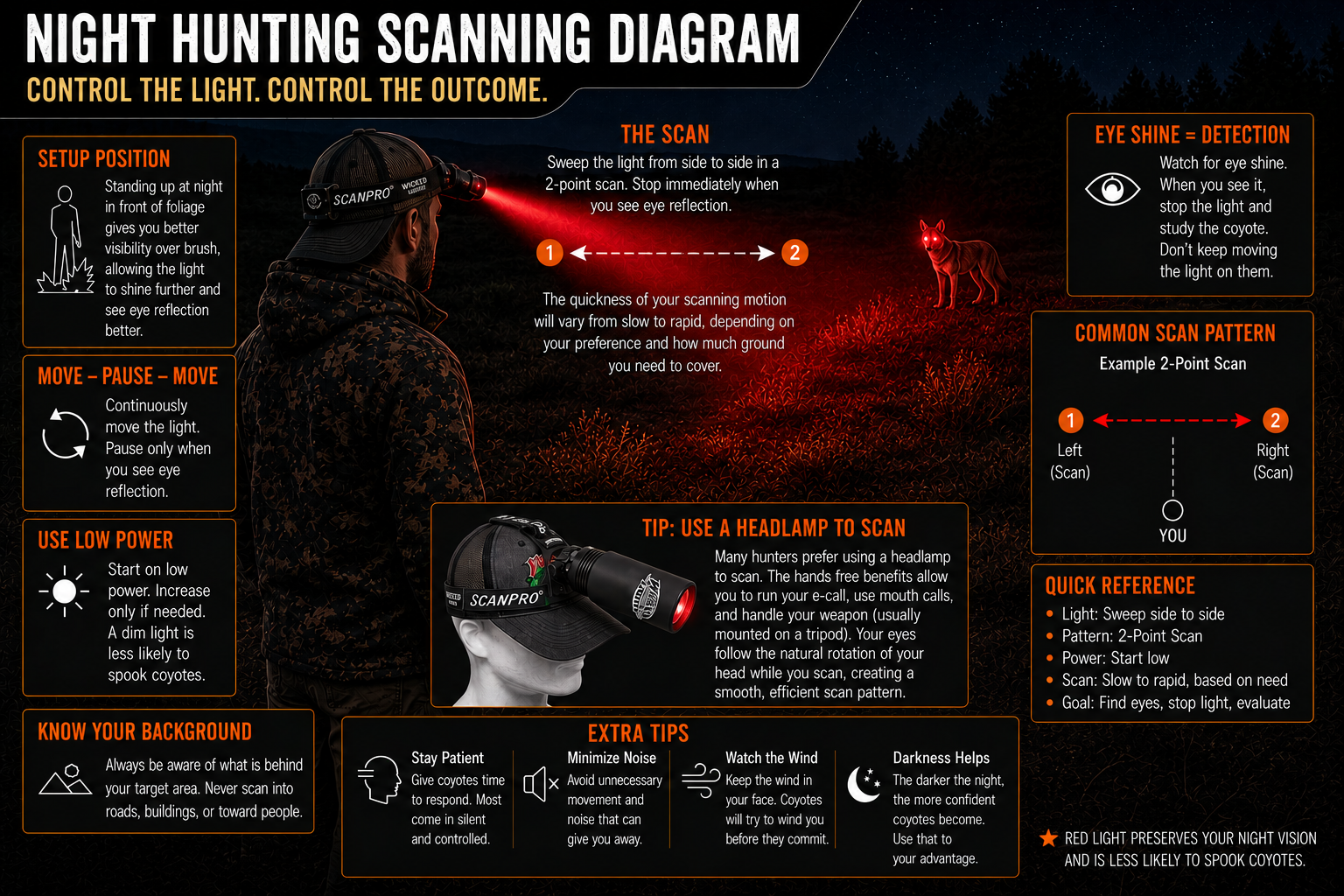
- Use quality scanning lights: Red, green, white, and infrared lights are commonly used for spotting approaching coyotes and identifying targets safely.
- Scan continuously and methodically: Slow, consistent scanning helps detect eye reflections and movement before coyotes get too close or circle downwind.
- Pre-scout during daylight: Learning terrain, shooting lanes, fence lines, and access routes during the day greatly improves nighttime safety and stand efficiency.
- Watch your downwind side carefully: Coyotes frequently attempt to scent-check the area before committing to the call, especially at night when visibility is limited.
- Keep shots within safe, confident distances: Night hunting reduces depth perception and visibility, making shot discipline extremely important.
- Use realistic calling sequences: Many hunters rely heavily on prey distress sounds at night, while others mix in vocals depending on the season and local pressure.
Modern night hunting lights and thermal or infrared equipment can dramatically improve visibility and scanning efficiency when used responsibly and legally.
Many experienced predator hunters prefer dedicated hunting lights with focused beams designed specifically for long-range identification and scanning.
Shop Night Hunting Lights →
Coyote hunting is one of the most challenging and rewarding forms of predator hunting. Every stand is different, and even experienced hunters regularly encounter unpredictable conditions, changing coyote behavior, and difficult setups.
Success often comes from patience, consistency, and the willingness to learn from both successful stands and difficult days in the field.
- Learn from every stand: Pay attention to wind direction, setup location, calling sequences, visibility, and coyote reactions after every hunt.
- Stay patient and persistent: Even experienced hunters have slow days. Consistency and time in the field are some of the biggest factors in long-term success.
- Adapt to changing conditions: Weather, hunting pressure, food sources, and seasonal behavior all influence how coyotes respond from one hunt to the next.
- Focus on stand quality over stand quantity: Carefully planned setups in active areas often outperform rushing through large numbers of random stands.
- Respect landowners and wildlife: Ethical hunting practices and positive relationships with landowners help preserve predator hunting opportunities for future hunters.
- Keep improving your skills: Scouting, calling, stand setup, shooting, and understanding coyote behavior all improve with experience and time in the field.
Many successful predator hunters spend years refining their techniques, learning local terrain, and adapting to changing conditions. The hunters who continue learning are often the ones who become consistently successful over time.
Continue Learning in Predator Hunting Academy →
Frequently Asked Questions
What is the best time of year to hunt coyotes?
Many hunters consider fall and winter the best seasons for coyote hunting because coyotes are highly active, food sources become more limited, and vocal responses often increase during breeding season.
What sounds work best for coyotes?
Rabbit distress, rodent distress, bird distress, pup distress, and coyote vocalizations are among the most effective sounds for calling coyotes throughout the year.
How long should you stay on a coyote stand?
Most coyote stands last between 15–30 minutes depending on terrain, visibility, hunting pressure, and coyote density in the area.
What wind direction is best for coyote hunting?
Most hunters prefer crosswinds because coyotes commonly attempt to approach from downwind before committing to a call.
Do electronic calls work better than mouth calls?
Both electronic callers and mouth calls are highly effective. Many experienced hunters use both depending on terrain, hunting pressure, and personal preference.
Can coyotes smell hunters easily?
Coyotes have an extremely strong sense of smell and frequently attempt to scent-check an area before fully approaching a call.
What is the best time of day to hunt coyotes?
Early morning and late evening are often the most productive times, although coyotes can respond throughout the day under the right conditions.
How far away should you place an electronic caller?
Many hunters place electronic callers roughly 30–60 yards away from their shooting position to help draw a coyote’s attention away from the hunter.
Are coyotes harder to hunt in pressured areas?
Coyotes living in heavily hunted areas often become more cautious, respond differently to sounds, and pay closer attention to movement, scent, and stand setup.
Is night hunting effective for coyotes?
Night hunting can be extremely effective where legal because coyotes often become more active and less cautious after dark.
